There's a meme going around today at Kos, TPM and the LA Times raising the spector of an "unnatural aristocracy" should Sen. Hillary Clinton be elected to President for two terms. If that should happen, then a Bush or a Clinton would have been President for 28 years.
What strikes me as odd is why the hubbub now, with 10 of those 28 years the subject of future speculation? Where was the hand wringing all along about our existing "unnatural aristocracy"? After all, the Republicans haven't nominated a national ticket without a Bush or a Dole on board since 1972, 35 years ago.
Just because Bill Clinton had the good fortune to marry a formidable partner named Rodham, we're supposed to believe our unnatural aristocracy is suddenly a bipartisan problem?
Monday, January 22, 2007


Friday, November 10, 2006
Job Hunting Tip for Out of Work Republicans
Now that the Democrats have taken control of Congress, hundreds of GOP Congressional staffers are now in a mad scramble for employment. "The hundreds of Republican staffers — not to mention more than a few Members — who will lose their jobs in the next few weeks are going to face a hostile marketplace on K Street as unemployed Republicans flood the market."
I really feel their pain. Really. That means the uber-patriots from GOP Congressional offices that shut down the Miami vote counting in 2000 below, are getting their pink slips soon.

Judging from that manufactured display of outrage, it's clear that their best career path is to join the CapitalOne credit card marketing team. What's (Left) in YOUR Wallet?

Miss ya already.
I really feel their pain. Really. That means the uber-patriots from GOP Congressional offices that shut down the Miami vote counting in 2000 below, are getting their pink slips soon.
Judging from that manufactured display of outrage, it's clear that their best career path is to join the CapitalOne credit card marketing team. What's (Left) in YOUR Wallet?
Miss ya already.
Sunday, November 05, 2006
Flashback: Rumsfeld's Handshake With Saddam
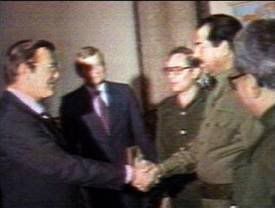
So Saddam Hussein has been found guilty of genocide against Kurds in 1982. Shock and surprise. How many of the 101st Fighting Keyboarders will now use that as justification for the Iraq War? Never mind that the US had no problem with Saddam's genocide at the time. That famous picture of Donald Rumsfeld shaking Saddam's hand took place about a year later, long after we knew full well what went down.
But what was the context of that picture?
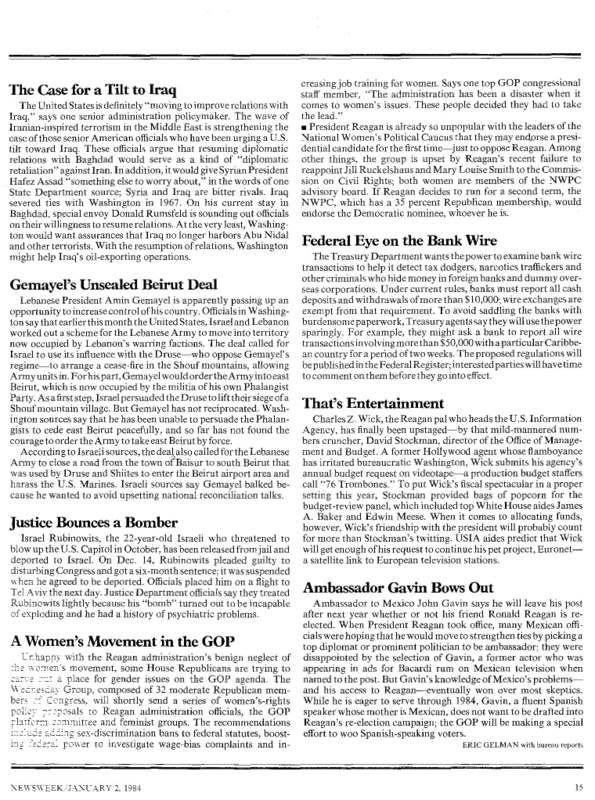
One problem with using the Google to surf the internets is that there's relatively little hard info pre-1990 to be found. That's not too surprising, since few people knew what the internet was in 1990. After a session of cleaning out my basement however, I came across this gem, a Newsweek from January 2, 1984. On the Periscope page is a news snippet describing the meetings leading up to that handshake:
(Here's a jpg of the actual page for those lacking trust in my transcription skills.)"The Case for a Tilt to Iraq
The United States is definitely "moving to improve relations with Iraq," says one senior administration policymaker. The wave of Iranian-inspired terrorism in the Middle East is strengthening the case of those senior American officials who have been urging a U.S. Tilt toward Iraq. These officials argue that resuming diplomatic relations with Baghdad would serve as a kind of "diplomatic retaliation" against Iran. In addition, it would give Syrian President Hafez Assad "something else to worry about," in the words of one State Department source; Syria and Iraq are bitter rivals. Iraq severed ties with Washington in 1967. On his current stay in Baghdad, special envoy Donald Rumsfeld is sounding out officials on their willingness to resume relations. At the very least, Washington would want assurances that Iraq no longer harbors Abu Nidal and other terrorists. With the resumption of relations, Washington might help Iraq's oil exporting operations."
So we see clearly why Rumsfeld was for Saddam before he was against Saddam. How embarrassing for him, to be this wrong AND inconsistent at the same time. We also see that EVEN THEN it all revolved around oil, despite it being presented in an "oh by the way" tone in Newsweek.
Friday, September 15, 2006
Cheer up! Congress is on the Job!
Take a look at our intrepid House of Representatives Armed Services Committee web page.
They've got a plan for Iraq! In fact, they've got an organized "Victory In Iraq" Caucus all set up and working to ensure our... well... Victory in Iraq!
Scroll down the page a little to the "Victory In Iraq Caucus" link for further details on all the excitement! I don't know about you, but I feel SO much better. Tip of the hat to Atrios for spotting this.
The Iraq War: We Told You So.

All right, I've tried to resist this for a long time. I really didn't want to do it. Well actually, I did. Here goes:
We Told You So. We Were Right. You Were Wrong.
The Iraq War is a devastating, bankrupting, economy destroying disaster. Each time you fill your tank up with $2 to 3+ gasoline, remember that:
We Told You So. We Were Right. You Were Wrong.
You don't remember that we warned you before the Iraq invasion? Well on October 14, 2002, six months before the invasion, the group I've been involved with, Business Leaders for Sensible Priorities, ran a full page ad in the New York Times entitled "They're Selling War. We're Not Buying". The ad spoke of how the war was marketed like a new product, and suggested that warning labels be attached to that product: "Warning: War Will Wreck the Economy"; "Warning: War Will Breed Terrorism"; "Warning: War Will Discredit America in the World's Eyes" and "Warning: War Will Take A Terrible Toll in Human Life".
In March 2003, BLSP marshaled 7 Nobel Prize winning economists and scores of other businesspeople to sign another New York Times full page ad, this time highlighting the economic cost of a war with Iraq. The message:
"Which is smarter? Spending $80 million a year to disarm Iraq peaceably -- or spending a thousand times more on a war? In a time of economic peril, such a crushing "war surcharge" could only be justified by a clear threat to our nation. Iraq presents no such threat."On March 6, 2003 I had the opportunity to co-sign a letter to President Bush asking to speak with him concerning the economic consequences of war. That letter predicted lower stock prices, higher oil prices, lower consumer confidence, forced cuts in Federal state and local government programs, disrupted transportation, tourism and shipping and a backlash against American brands abroad. Of those predictions, all have come to pass at least somewhat except one: the stock market is higher than it was in 2003, partly fueled by huge gains in the defense and oil industries.
Of course, none of these ads and letters stopped the war from happening. BLSP didn't give up though. In March 2004 I had the privilege of representing BLSP in Washington unveiling a campaign kicked off by an ad in the New York Times signed by over 70 national business leaders titled: "Have you noticed what's happening to Chief Executives who lie?" and observed:
"We now know that the case the President made for his war was built almost entirely out of falsehoods."Later, after the devastation of Hurricane Katrina and the dysfunctional Federal response became obvious to all, again it was business leaders that connected the dots with the Iraq War's drain on our resources, observing:
"They died because the infrastructure of this great nation has been allowed to go to hell in favor of war in Iraq. They died because the National Guardsmen who could have saved lives were shipped off to that war.Now we see the result of this war. Cost estimates range in the trillions. Well over 2,600 American soldiers killed, as well as over 100,000 Iraqi civilians. Anti-American fervor is at a fever pitch in the Islamic world. We have lost all trace of respect and political capital in the world. We're generating hundreds of billions of new government debt owed to foreign governments largely as a result of this disaster. Oil is so expensive that when it drops below $70 per barrel, it's treated as good news. Sectarian violence and anarchy rules in Baghdad and elsewhere in Iraq. There were no weapons of mass destruction found, save some leftover spoiled canisters that the Reagan administration sold to Saddam in the 80's.
The myopia is mind-boggling. This very year hurricane protection projects around Lake Pontchartrain were slashed by 79%. Flood prevention projects in New Orleans took a 53% hit. The Corps of Engineers leader who complained was ousted. FEMA was gutted. Nothing not shaped like a Pentagon got adequate funding from this administration."
We Told You So.
If you're a businessperson, go join BLSP so the message can continue. If you're not a businessperson, go join their sister group True Majority. Enough is enough.
Sunday, November 27, 2005
If You Want to Cut Pork, Go to the Pentagon
(Here's the post I spoke of in my last entry.)
The Truth Laid Bear wants all good bloggers to support a bill put forth by a handful of conservative Republican Senators called "The Fiscal Watch Team Offset Package", This bill ostensibly offsets the costs of Hurricane Katrina with a bunch of Federal budget cuts to Medicare and a 5% reduction in all domestic spending. This is apparently a litmus test for bloggers and politicians alike. Support the bill with a specific declaration on your blog, and you are a "Porkbuster". Oppose the bill, and you favor profligate government waste. Faithful right-thinking bloggers are then supposed to declare their support on their blogs, to then be highlighted on the TTLB site. Look closer however, and the whole deal appears to be just another right wing attempt to frame opposition to domestic spending as "trimming wasteful pork".
I would like to say "I support the Fiscal Watch Team Offset Package", but I can't. It's a terrible, highly partisan bill that targets all the wrong areas and lets the main sources of government pork go untouched. This "package" would slash domestic spending across the board by 5%, increase Medicare costs and freeze COLA adjustments for non-military personnel. The recent pay hikes for Congressmen are not affected, nor are any military programs. This package is supposed to save $130 billion in 2 years. The fact that the Medicare savings don't accrue to the benefit of the Federal Budget (being an off-budget Trust Fund program) is apparently lost on our intrepid budget cutters.
 Well this is just balderdash. Most of the waste in government takes place in the military side of the ledger. In this chart, the red pie slice is the military's portion of all Federal discretionary spending. All, except for one important distinction: the Iraq and Afghanistan operations are funded by off budget emergency appropriations. What you see is the military budget minus our current wars du jour. So when our arch-conservative (and downright loopy) freshman Senator Tom Coburn (R, Mars) exempts all military spending from cuts, he's walking away from the biggest pie slice of all. Of course, that's intentional. The military is the Republicans' third rail, just as domestic spending such as Medicare and Social Security are the Democrats'. This bill therefore is merely a Trojan Horse partisan attack on the Democrats wrapped in anti-pork rhetoric.
If anyone is serious on Capitol Hill about reducing wasteful spending, you have to look at the Pentagon first. Defense Secretary Rumsfeld admitted in 2002 that the Pentagon has lost track of an estimated $2.3 trillion of military transactions. That's $2.3 trillion or over $8,000 for every man woman and child living in the USA. Contrast that with the $77 per person cost of pork identified in the Porkbusters database so far, and the $448 per person that Coburn's bill claims to save. And that before the Iraq War started, before Halliburton snagged those no bid contracts, before those untold billions were unaccounted for in the Iraq reconstruction budget. It's so bad, non-partisan tax watchdog Taxpayers for Common Sense said in 2003:
It's not just accounting incompetence though, it's deliberate policy decisions that waste hundreds of billions of dollars. Dr. Lawrence Korb, Asst Secy of Defense under Ronald Reagan, recently wrote a complete analysis of today's military programs. By targeting wasteful weapons systems designed to fight cold war enemies that no longer exist, he's found over $60 billion per year that could be cut from military budgets that actually would strengthen our national security.
Here's just one example from Korb's Report of the kind of unneeded pork we should cut: the V-22 Osprey program. This dog is a tilt rotor craft that takes off like a helicoptor and then flies like a plane. Or at least that's what it's supposed to do. Originally ordered in the 80's, it was dropped by the Army in the late 80's because of enormous technical problems and field test failures. Then-Sec'y of Defense Dick Cheney canceled the program in 1991. It was revived by Congress however and continued to live on in Pentagon budgets ever since. Several serious accidents in continued testing make the Osprey more deadly for our Armed Forces than the entire Kosovo War. The total cost of this dog is up to $50 billion. A little over $500 million was spent on payments to military contractors in FY2003, spread throughout two dozen different congressional districts. This dog should go before it kills any more Marines.
You want another piece of pork to dispense with? It's called "Operation Iraqi Freedom", an unforgiveable boondoggle that wastes $5.8 billion per month. That's $70 billion per year.
Follow Korb's advice on the traditional budget, and follow Congressman Murtha's advice on Iraq, and we'll have saved $260 billion over the next two years while actually strengthening military preparedness. That's twice what the Senator Coburn's package wants to slash, without snatching Medicare benefits from those who need them and slashing every domestic priority we have bedsides.
Dr. Korb presented the idea of his military cuts in October within days of Sen Coburn's Medicare and domestic cut package. But the TTLM "Porkbusters" effort apparently will have none of that. Only domestic programs are attacked in their database they've set up. Yet just that one Marine-killing Osprey program costs more than all of the pork identified in that database put together. So is "porkbusters" just a right wing framing campaign against domestic spending, or are they serious about actually trimming bigtime wasteful spending? It will be very interesting if Korb's recommendations ever makes it on the "Porkbusters" site.
The Truth Laid Bear wants all good bloggers to support a bill put forth by a handful of conservative Republican Senators called "The Fiscal Watch Team Offset Package", This bill ostensibly offsets the costs of Hurricane Katrina with a bunch of Federal budget cuts to Medicare and a 5% reduction in all domestic spending. This is apparently a litmus test for bloggers and politicians alike. Support the bill with a specific declaration on your blog, and you are a "Porkbuster". Oppose the bill, and you favor profligate government waste. Faithful right-thinking bloggers are then supposed to declare their support on their blogs, to then be highlighted on the TTLB site. Look closer however, and the whole deal appears to be just another right wing attempt to frame opposition to domestic spending as "trimming wasteful pork".
I would like to say "I support the Fiscal Watch Team Offset Package", but I can't. It's a terrible, highly partisan bill that targets all the wrong areas and lets the main sources of government pork go untouched. This "package" would slash domestic spending across the board by 5%, increase Medicare costs and freeze COLA adjustments for non-military personnel. The recent pay hikes for Congressmen are not affected, nor are any military programs. This package is supposed to save $130 billion in 2 years. The fact that the Medicare savings don't accrue to the benefit of the Federal Budget (being an off-budget Trust Fund program) is apparently lost on our intrepid budget cutters.
 Well this is just balderdash. Most of the waste in government takes place in the military side of the ledger. In this chart, the red pie slice is the military's portion of all Federal discretionary spending. All, except for one important distinction: the Iraq and Afghanistan operations are funded by off budget emergency appropriations. What you see is the military budget minus our current wars du jour. So when our arch-conservative (and downright loopy) freshman Senator Tom Coburn (R, Mars) exempts all military spending from cuts, he's walking away from the biggest pie slice of all. Of course, that's intentional. The military is the Republicans' third rail, just as domestic spending such as Medicare and Social Security are the Democrats'. This bill therefore is merely a Trojan Horse partisan attack on the Democrats wrapped in anti-pork rhetoric.
If anyone is serious on Capitol Hill about reducing wasteful spending, you have to look at the Pentagon first. Defense Secretary Rumsfeld admitted in 2002 that the Pentagon has lost track of an estimated $2.3 trillion of military transactions. That's $2.3 trillion or over $8,000 for every man woman and child living in the USA. Contrast that with the $77 per person cost of pork identified in the Porkbusters database so far, and the $448 per person that Coburn's bill claims to save. And that before the Iraq War started, before Halliburton snagged those no bid contracts, before those untold billions were unaccounted for in the Iraq reconstruction budget. It's so bad, non-partisan tax watchdog Taxpayers for Common Sense said in 2003:
"DOD is by far the most fiscally mismanaged agency. The GAO has said that overhauling the Pentagon's financial management will be a major challenge "that goes far beyond financial accounting to the very fiber of the department's business operations and management culture." In fact, no major part of DOD has ever passed an audit and the Pentagon readily admits that flawed business systems and practices are common within the agency. They claim it would take decades to get all of the agency books in order."
It's not just accounting incompetence though, it's deliberate policy decisions that waste hundreds of billions of dollars. Dr. Lawrence Korb, Asst Secy of Defense under Ronald Reagan, recently wrote a complete analysis of today's military programs. By targeting wasteful weapons systems designed to fight cold war enemies that no longer exist, he's found over $60 billion per year that could be cut from military budgets that actually would strengthen our national security.
Here's just one example from Korb's Report of the kind of unneeded pork we should cut: the V-22 Osprey program. This dog is a tilt rotor craft that takes off like a helicoptor and then flies like a plane. Or at least that's what it's supposed to do. Originally ordered in the 80's, it was dropped by the Army in the late 80's because of enormous technical problems and field test failures. Then-Sec'y of Defense Dick Cheney canceled the program in 1991. It was revived by Congress however and continued to live on in Pentagon budgets ever since. Several serious accidents in continued testing make the Osprey more deadly for our Armed Forces than the entire Kosovo War. The total cost of this dog is up to $50 billion. A little over $500 million was spent on payments to military contractors in FY2003, spread throughout two dozen different congressional districts. This dog should go before it kills any more Marines.
You want another piece of pork to dispense with? It's called "Operation Iraqi Freedom", an unforgiveable boondoggle that wastes $5.8 billion per month. That's $70 billion per year.
Follow Korb's advice on the traditional budget, and follow Congressman Murtha's advice on Iraq, and we'll have saved $260 billion over the next two years while actually strengthening military preparedness. That's twice what the Senator Coburn's package wants to slash, without snatching Medicare benefits from those who need them and slashing every domestic priority we have bedsides.
Dr. Korb presented the idea of his military cuts in October within days of Sen Coburn's Medicare and domestic cut package. But the TTLM "Porkbusters" effort apparently will have none of that. Only domestic programs are attacked in their database they've set up. Yet just that one Marine-killing Osprey program costs more than all of the pork identified in that database put together. So is "porkbusters" just a right wing framing campaign against domestic spending, or are they serious about actually trimming bigtime wasteful spending? It will be very interesting if Korb's recommendations ever makes it on the "Porkbusters" site.
Putting Porkbusters to the Test
In the aftermath of a wonderful Thanksgiving celebration, I was poking around the blogosphere and came across a growing site called "The Truth Laid Bear", which styles itself as a "fully developed portal to the blogosphere". It's pretty impressive too, with something like 7K visits per day and close to 50,000 blogs registered as part of the "TTLB Ecosystem". OK, so I registered my small blog with the group and was immediately branded an "Insignificant Microbe". Dudes, you might want to check with your publicist on the wisdom of that initial Out of the Box Experience. Subsequent scans by their software promoted me to "Slimy Mollusc". I feel so vindicated.
In any event it looks like a pretty nifty community to bop around in. One part of the site that drew my attention, being the hopeless would-be polysci wonk that I am, was a campaign called "Porkbusters". This brainchild of Instapundit is a great idea. It invites all bloggers to identify some particularly noisome example of government waste or pork and blog about it. We're also asked to pressure our Congresscritters to eliminate said pork forthwith. Porkbusters also promises to post each example on their site so that the whole community can share in the outrage.
Well I'm going to put this to the test. You see, the whole campaign appears to have a decidedly rightward tilt. Looking through the pork cited, all of it comes from domestic non military spending. Yet about 50% of the discretionary budget is devoted to the military, not including the Iraq and Afghanistan operations. My suspicions were confirmed by Porkbusters' highlighting of a right wing attempt to cut social programs, framed as the "Fiscal Watch Team Offset Package", an attempt to offset the expenses of cleaning up after Hurricanes Katrina and Rita.
So my next post will highlight some Pentagon pork. Let's see if the TTLB Ecosystem is up to including that in their efforts.
In any event it looks like a pretty nifty community to bop around in. One part of the site that drew my attention, being the hopeless would-be polysci wonk that I am, was a campaign called "Porkbusters". This brainchild of Instapundit is a great idea. It invites all bloggers to identify some particularly noisome example of government waste or pork and blog about it. We're also asked to pressure our Congresscritters to eliminate said pork forthwith. Porkbusters also promises to post each example on their site so that the whole community can share in the outrage.
Well I'm going to put this to the test. You see, the whole campaign appears to have a decidedly rightward tilt. Looking through the pork cited, all of it comes from domestic non military spending. Yet about 50% of the discretionary budget is devoted to the military, not including the Iraq and Afghanistan operations. My suspicions were confirmed by Porkbusters' highlighting of a right wing attempt to cut social programs, framed as the "Fiscal Watch Team Offset Package", an attempt to offset the expenses of cleaning up after Hurricanes Katrina and Rita.
So my next post will highlight some Pentagon pork. Let's see if the TTLB Ecosystem is up to including that in their efforts.
Sunday, October 30, 2005
GOP Senate to Workers: It's Fine to Be Paid 1/3rd Less Than Depression-Era Laborers
First, some perspective. Pictured here are some day laborers working on construction of the Hoover Dam in 1932.

These men were part of a corps of 5,000 men paid 50 cents an hour to do the dirty unskilled labor that created the magnificent dam over 5 years of hard dangerous work. Those who got that 50 cents an hour considered themselves lucky, as wage rates were depressed by the height of the Great Depression. Still, labor unions at the time bitterly denounced the wage rates and working conditions of the Hoover Dam laborers:
Now fast forward to 2005. The GOP dominated US Senate has just voted down the first increase of the minimum wage since 1997: from $5.15 to $6.25 an hour. All the Democrats plus four Republicans voted for it. It failed 51-49. In the time since the last increase in the minimum wage, Senators voted themselves seven pay raises totaling $28,000 per year.
What does this have to do with the Hoover Dam workers? Well, 50 cents an hour in the Depression translates into $7.89 per hour in today's dollars. (Don't believe me? Do the math with the historical Consumer Price Index.) What the Senate is saying is that today's minimum wage workers should be getting a wage 35% LOWER than unskilled, non-union labor in the height of the Great Depression. This is progress? No. It's a crime against Americans. Next election time, remember who did this to us.

These men were part of a corps of 5,000 men paid 50 cents an hour to do the dirty unskilled labor that created the magnificent dam over 5 years of hard dangerous work. Those who got that 50 cents an hour considered themselves lucky, as wage rates were depressed by the height of the Great Depression. Still, labor unions at the time bitterly denounced the wage rates and working conditions of the Hoover Dam laborers:
"We believe that a great injustice is being perpetrated against the workers at Boulder Dam in the general lowering of working and living conditions on a project directly under the supervision of our Government during this time of depression and unemployment. Labor at Boulder Dam has no voice in the settling of wages, hours of labor, working conditions, safety or living conditions. Last year local Labor Unions attempted to have the Bacon-Davis prevailing wage law apply to the Boulder Canyon project and Boulder City. An investigation by the conciliation Division of the Department of Labor found that the Bacon-Davis Act did not become a law until two days after the Six Companies signed their contract. Further, that reservations were not covered by the prevailing rate of wage law and the result was a general lowering of wages and working conditions. An arbitrary scale of wage was imposed on skilled mechanics twenty-five to fifty percent lower than the prevailing scales for similar work in the territory adjacent to the project."Picture and quote from the Boulder City/Hoover Dam Museum. Go there if you're in Vegas sometime. It's an incredible story they tell.
Now fast forward to 2005. The GOP dominated US Senate has just voted down the first increase of the minimum wage since 1997: from $5.15 to $6.25 an hour. All the Democrats plus four Republicans voted for it. It failed 51-49. In the time since the last increase in the minimum wage, Senators voted themselves seven pay raises totaling $28,000 per year.
What does this have to do with the Hoover Dam workers? Well, 50 cents an hour in the Depression translates into $7.89 per hour in today's dollars. (Don't believe me? Do the math with the historical Consumer Price Index.) What the Senate is saying is that today's minimum wage workers should be getting a wage 35% LOWER than unskilled, non-union labor in the height of the Great Depression. This is progress? No. It's a crime against Americans. Next election time, remember who did this to us.
Sunday, October 02, 2005
The Called Ball Didn't Fall: Bush Tax Cuts an Objective Failure
Reality is an inconvenient thing sometimes. In the polarized atmosphere of today's politics, reality is often hard to come by. Everyone has their spin, their set of facts and warping of same. Because of this, no one trusts what the other side is saying, and perhaps rightly so. That's why I like to get back to basics and simply rely on hard primary data that no one can dispute or question. So when a friend in another forum claimed that the Bush administration's tax cuts actually worked to foster economic growth and raise tax receipts (as reported by USA Today), I thought it was time to look at the facts.
When playing pool, the way players prevent one another from benefiting from lucky shots is to require each player to call what shot he/she is trying to make. If it happens, then fine. If something else happens, like the wrong ball falling into the wrong pocket, it doesn't count. The President's budget message to Congress each January is the fiscal politics version of calling your shots, though the administration would like us to forget this.
Each year the President's budget message contains five year projections of where the administration thinks revenues, spending and deficits will be. These projections are based upon the enactment of whatever tax and spending plan the President proposes with the message. So if a President suggests a bold new tax cut for example, the predicted effects of that tax cut are built into the numbers. What that means is that revisiting those numbers afterwards tells us if the predictions actually happened the way they predicted.
These numbers distill all of the spin, all the arguments, loaded catchphrases and sales slogans down to mathematical objective reality. In this case the numbers are produced and are sourced from the administration itself in a audited and vetted procedure that no one of either party has questioned for decades. So no one on either side of the aisle should be able to quibble with them.
In January 2002, after 9/11 and President Bush's first round of tax cuts, the administration suggested the rest of their major tax cuts and predicted a swift economic rebound. 9/11 was blamed for the deterioration of Federal finances leading to a $106 billion deficit projected in 2002, the first since 1997. Enacting the Bush plan for 2002 would
Those forecasts led to projects that by FY2004, economic growth would have been such to generate $2,175 billion in revenues. Offsetting that was $2,189 billion in spending, or a deficit of only $14 billion. Don't take my word for it. The Bush administration figures here are at the OMB's website in Excel, and Lotus 123.
Well 2004 has come and gone. The speeches are all done, the beans all counted. Here then is the REAL "No-Spin Zone". The final report on spending in 2004 comes to us in the President's budget message in January 2005. Bush reported that revenues came in at $1,880 billion, while spending was $2,292 billion.
Let's review. Actual revenues were $295 billion less than what the administration predicted would be the result of their economic growth and tax plan. They were off by almost 14%. They called their shot. The called ball didn't fall in the called pocket. Not even close. The period between prediction and outcome started AFTER 9/11 and ended BEFORE Katrina, so no excuses can be given for unforeseen events.
Now, Keynesian economics posits that raising deficit spending can sometimes jumpstart economic growth. Could any spending restraint by the administration have dampened growth during this time? Hardly. Bush administration projections called for them spending $2,189 billion a year by FY2004. Actual spending came in $103 billion MORE than what they had promised to do. No restraint there. The called ball didn't fall. Not even close.
So what of my friend who pointed to state government revenues as proof the tax cuts were working? Well, the Center for Budget and Policy Priorities looks at state government finances closer than any other public source I know. Their data suggests that this area is subject to immense political spin. Turns out State government finances are still in fiscal crisis, though deficits are beginning to shrink. In other words, the growth we are seeing now merely is catching up from the fall those revenues took in recent years. Further, many states are "decoupling" various tax deduction items found in Federal tax codes, a stealth tax increase raising state taxes without fanfare or much notice.
In other words, while state tax revenues might be rising, they signify nothing but an accidental ball falling into the pocket, uncalled by any player. It's just not relevant to answering the question of whether Bush's tax cuts are working. The called ball didn't fall. End of story.
When playing pool, the way players prevent one another from benefiting from lucky shots is to require each player to call what shot he/she is trying to make. If it happens, then fine. If something else happens, like the wrong ball falling into the wrong pocket, it doesn't count. The President's budget message to Congress each January is the fiscal politics version of calling your shots, though the administration would like us to forget this.
Each year the President's budget message contains five year projections of where the administration thinks revenues, spending and deficits will be. These projections are based upon the enactment of whatever tax and spending plan the President proposes with the message. So if a President suggests a bold new tax cut for example, the predicted effects of that tax cut are built into the numbers. What that means is that revisiting those numbers afterwards tells us if the predictions actually happened the way they predicted.
These numbers distill all of the spin, all the arguments, loaded catchphrases and sales slogans down to mathematical objective reality. In this case the numbers are produced and are sourced from the administration itself in a audited and vetted procedure that no one of either party has questioned for decades. So no one on either side of the aisle should be able to quibble with them.
In January 2002, after 9/11 and President Bush's first round of tax cuts, the administration suggested the rest of their major tax cuts and predicted a swift economic rebound. 9/11 was blamed for the deterioration of Federal finances leading to a $106 billion deficit projected in 2002, the first since 1997. Enacting the Bush plan for 2002 would
"...boost 2002 GDP growth by 0.5 percent and lead to the creation of 300,000 more jobs. The Administration has built its economic forecasts around the assumption that an economic stimulus package will be enacted."
Those forecasts led to projects that by FY2004, economic growth would have been such to generate $2,175 billion in revenues. Offsetting that was $2,189 billion in spending, or a deficit of only $14 billion. Don't take my word for it. The Bush administration figures here are at the OMB's website in Excel, and Lotus 123.
Well 2004 has come and gone. The speeches are all done, the beans all counted. Here then is the REAL "No-Spin Zone". The final report on spending in 2004 comes to us in the President's budget message in January 2005. Bush reported that revenues came in at $1,880 billion, while spending was $2,292 billion.
Let's review. Actual revenues were $295 billion less than what the administration predicted would be the result of their economic growth and tax plan. They were off by almost 14%. They called their shot. The called ball didn't fall in the called pocket. Not even close. The period between prediction and outcome started AFTER 9/11 and ended BEFORE Katrina, so no excuses can be given for unforeseen events.
Now, Keynesian economics posits that raising deficit spending can sometimes jumpstart economic growth. Could any spending restraint by the administration have dampened growth during this time? Hardly. Bush administration projections called for them spending $2,189 billion a year by FY2004. Actual spending came in $103 billion MORE than what they had promised to do. No restraint there. The called ball didn't fall. Not even close.
So what of my friend who pointed to state government revenues as proof the tax cuts were working? Well, the Center for Budget and Policy Priorities looks at state government finances closer than any other public source I know. Their data suggests that this area is subject to immense political spin. Turns out State government finances are still in fiscal crisis, though deficits are beginning to shrink. In other words, the growth we are seeing now merely is catching up from the fall those revenues took in recent years. Further, many states are "decoupling" various tax deduction items found in Federal tax codes, a stealth tax increase raising state taxes without fanfare or much notice.
In other words, while state tax revenues might be rising, they signify nothing but an accidental ball falling into the pocket, uncalled by any player. It's just not relevant to answering the question of whether Bush's tax cuts are working. The called ball didn't fall. End of story.
Sunday, September 11, 2005
Feds Were Not Always This Incompetent: The Response to Hurricane Marilyn
Will wonders never cease? A friend of mine pointed me to an article in the National Review criticizing the Bush Administration's response to Katrina. They were pretty enthusiastic. Unfortunately, they were blaming bureaucracy in general, as if the notion of a government agency included incompetence by definition, wrapping it up with: "Unfortunately, there is not much that can be done to make bureaucracy less bureaucratic."
You can excuse the NatReview for feeling this way. After all, conservatives spend all their time when they're out of power complaining how government doesn't work. Then when in power they spend all their time proving the point.
There is a way to make government work though. You have to want it to work. You have to give a damn about the mission you're about. Then, all things can be possible.
I was looking around to find out how well the Feds have responded to previous hurricanes and came across this excellent resource at the Quick Response Program and the Natural Hazards Center of the University of Colorado. That center reminded me of an excellent test case measuring the response of the Bush I and Clinton administrations to similar situations. In 1989
the Bush administration spearheaded relief efforts in the US Virgin Islands following Hurricane Hugo, while the Clinton administration relied on many of the same personnel and resources to respond to Hurricane Marilyn's USVI destruction six years later.
Quick Response Report #82 , written by Betty Hearn Morrow and A. Kathleen Ragsdale of the International Hurricane Center of Florida International University, reported on the response to Marilyn, with specific reference to comparing that response to Hugo. The Hugo response was very unsatisfactory:
Was the vastly quicker response to Katrina due to a much more talented force on the ground? No, most of the people involved were also involved with Hugo's response and could compare the two:
The Clinton administration responded much quicker, with humanitarian disaster relief in position in real time, offering much faster response to a devastating situation in St. Thomas. Because help was already there, looting by desperate people never happened.
Fast forward to Bush II's administration, which reverted to Bush I's pathetic too late and a dollar short response to Hugo. Once again the main initial concern was sending in the troops to stop looting, instead of disaster relief efforts. Once again help comes days too late.
The difference in these situations is that the Clinton administration WANTED to use government to make a difference for people. It's part and parcel to the Democratic Party ideology. The Republicans on the other hand have since Reagan wanted to shrink government down to a size small enough so that he could "drown it in a bathtub", as Grover Norquist famously said.
In a recent blog post I opined that right wingers were not qualified to run government, because their incompetence sprang from the simple fact that they hate their jobs, preferring to drown their jobs in a bathtub rather than execute them to the best of their ability. That blog post went up months ago. Unfortunately, Katrina just added a deadly exclamation point to the argument.
You can excuse the NatReview for feeling this way. After all, conservatives spend all their time when they're out of power complaining how government doesn't work. Then when in power they spend all their time proving the point.
There is a way to make government work though. You have to want it to work. You have to give a damn about the mission you're about. Then, all things can be possible.
I was looking around to find out how well the Feds have responded to previous hurricanes and came across this excellent resource at the Quick Response Program and the Natural Hazards Center of the University of Colorado. That center reminded me of an excellent test case measuring the response of the Bush I and Clinton administrations to similar situations. In 1989
the Bush administration spearheaded relief efforts in the US Virgin Islands following Hurricane Hugo, while the Clinton administration relied on many of the same personnel and resources to respond to Hurricane Marilyn's USVI destruction six years later.
Quick Response Report #82 , written by Betty Hearn Morrow and A. Kathleen Ragsdale of the International Hurricane Center of Florida International University, reported on the response to Marilyn, with specific reference to comparing that response to Hugo. The Hugo response was very unsatisfactory:
"In the aftermath of Hurricane Hugo, many St. Croix residents had expressed anger that the first federal planes to finally arrive several days after the storm carried troops armed with guns, not food and water, in what many felt was an overreaction to earlier looting reports (Morrow, 1992). There was a strong racial tone to the perception of many that the U.S. troops had arrived to protect white tourists from black locals, not to provide disaster assistance to the U.S. citizens of St. Croix, most of whom were people of color."The notion that a majority Black community had to wait several days for Federal relief efforts to arrive should have a familiar ring to it for anyone following the controversy of Federal response to Katrina in New Orleans. Even so, was that just a function of the remoteness of the Virgin Islands and the difficulty in mobilizing a large relief effort? Apparently not, as the Clinton administration's response to Marilyn was quite different:
"In anticipation of their need, a number of FEMA disaster specialists had been sent to St. Thomas before Hurricane Marilyn's landfall. By daybreak on September 16, relief supplies and personnel had already begun arriving (FEMA, 1995e). This was the first deployment of the new Federal Interagency/State Field Assessment Team designed to provide quick and technically accurate early damage assessments. According to their reports, St. Thomas received the heaviest impact - 80% of the homes were damaged, 40% were uninhabitable, and 20-30% of the businesses were destroyed (FEMA, 1995b, 1995c)...So all of this happened "within one week", meaning that much of the work was already done on the ground in the time that the Federal Katrina responders took to glom onto the fact that they needed to respond at all.
"Within one week after the storm, FEMA had directed close to 60 strategic missions transporting more than 1,500 emergency personnel and 1.3 million tons of essential cargo, including food, water, and plastic sheeting for roofs (FEMA, 1995a). Federal Coordinating Officer Dennis Kwiatkowski was quoted as saying, "We are pulling out all the stops in getting supplies down here to make recovery happen" (FEMA, 1995e). Five distribution sites were being operated by the Virgin Islands Territorial Emergency Management Agency (VITEMA) on St. Thomas. More than 2,100 federal agency personnel had been deployed. Four contracts had been awarded for immediate housing repairs. Dive teams had begun assessing infrastructural damage to the area's harbors and Navy Seabees had begun structural repairs to public buildings. Military and security forces included about 500 Army, Air Force, and Navy personnel, 500 National Guardsmen, and 500 federal law enforcement personnel (FEMA, 1995d). All major roads had been cleared, the St. Thomas airport was open for visual flight operations using a mobile air traffic control tower, and the St. Thomas Hospital was operational using generators for power."
Was the vastly quicker response to Katrina due to a much more talented force on the ground? No, most of the people involved were also involved with Hugo's response and could compare the two:
"Indeed one veteran FEMA reservist made these unsolicited remarks: "One thing that is noteworthy for your study, is that we seem to have had more active Army with weapons at Hugo. Here we have an adequate supply of federal marshals and they're doing a good job, but they [the military] were much more noticeable at Hugo. He had been one of the first FEMA workers to be sent to St. Croix after Hugo, which he attributed to having a military background. Yet, he stated, "I never felt one iota threatened on St. Croix . . . Other than the tension involved with going through one of these things [a hurricane], I found the people very helpful and honest." He had driven his rental car all over the island and was often helped when he lost his way. There was a general feeling that the atmosphere was more relaxed on St. ThomasSo the Bush I Administration waited several days before getting help to the victims of Hurricane Hugo. When help arrived the first response was to send in the army to stop looting.
and, yet, the recovery process was going a lot faster than it had six years earlier on St. Croix."
The Clinton administration responded much quicker, with humanitarian disaster relief in position in real time, offering much faster response to a devastating situation in St. Thomas. Because help was already there, looting by desperate people never happened.
Fast forward to Bush II's administration, which reverted to Bush I's pathetic too late and a dollar short response to Hugo. Once again the main initial concern was sending in the troops to stop looting, instead of disaster relief efforts. Once again help comes days too late.
The difference in these situations is that the Clinton administration WANTED to use government to make a difference for people. It's part and parcel to the Democratic Party ideology. The Republicans on the other hand have since Reagan wanted to shrink government down to a size small enough so that he could "drown it in a bathtub", as Grover Norquist famously said.
In a recent blog post I opined that right wingers were not qualified to run government, because their incompetence sprang from the simple fact that they hate their jobs, preferring to drown their jobs in a bathtub rather than execute them to the best of their ability. That blog post went up months ago. Unfortunately, Katrina just added a deadly exclamation point to the argument.
Subscribe to:
Posts (Atom)