Bill Moyer's Journal has possibly the most important discussion found on TV this century so far: a discussion of impeachment with conservative Bruce Fein and progressive John Nichols. As a constitutional law scholar, Fein helped draft the impeachment articles against Bill Clinton and has long been a fixture at right wing think tanks and media outlets. Nichols is Washington correspondent for the Nation and the author of the book "the Genius of Impeachment". Together they make the case for impeaching both Bush and Cheney for their imperial behaviors as absolutely necessary to preserve the Constitution in future terms.
I highly recommend that you watch the show, or if you're computer is video challenged, read the transcript.
If this show motivates you to action, then what? Well, True Majority makes it easy to write your Congressperson to tell them to act on impeaching Dick Cheney. Now.
OpEd News and Peoples' E-Mail Network also has a nifty utility where you can write your thoughts about impeachment in an online form. They can then be sent automatically to your nearest newspaper as well as to your own representatives in Congress.
For lurking conservatives unconvinced by Bruce Fein's arguments about upholding the Constitution, just ponder one thought: President Hillary Clinton. Do you as a conservative want her to have the same powers that Bush enjoys today?
Take action.
Showing posts with label Politics. Show all posts
Showing posts with label Politics. Show all posts
Sunday, July 15, 2007


Sunday, June 24, 2007
Oil, Republicans and the Rise of Terrorism
I've tried to keep this blog around for occasional original content, rather than more frequent links to cool stuff laying around the tubes of the internets. However, this analysis from the Existentialist Cowboy merits special attention.
The connection between oil, Republican administrations and the rise of terrorism is nailed:
The connection between oil, Republican administrations and the rise of terrorism is nailed:
"So much so that one would think GOP regimes cause terrorism."Must read stuff here.
Monday, January 22, 2007
Our "Unnatural Aristocracy"
There's a meme going around today at Kos, TPM and the LA Times raising the spector of an "unnatural aristocracy" should Sen. Hillary Clinton be elected to President for two terms. If that should happen, then a Bush or a Clinton would have been President for 28 years.
What strikes me as odd is why the hubbub now, with 10 of those 28 years the subject of future speculation? Where was the hand wringing all along about our existing "unnatural aristocracy"? After all, the Republicans haven't nominated a national ticket without a Bush or a Dole on board since 1972, 35 years ago.
Just because Bill Clinton had the good fortune to marry a formidable partner named Rodham, we're supposed to believe our unnatural aristocracy is suddenly a bipartisan problem?
What strikes me as odd is why the hubbub now, with 10 of those 28 years the subject of future speculation? Where was the hand wringing all along about our existing "unnatural aristocracy"? After all, the Republicans haven't nominated a national ticket without a Bush or a Dole on board since 1972, 35 years ago.
Just because Bill Clinton had the good fortune to marry a formidable partner named Rodham, we're supposed to believe our unnatural aristocracy is suddenly a bipartisan problem?
Friday, November 10, 2006
Job Hunting Tip for Out of Work Republicans
Now that the Democrats have taken control of Congress, hundreds of GOP Congressional staffers are now in a mad scramble for employment. "The hundreds of Republican staffers — not to mention more than a few Members — who will lose their jobs in the next few weeks are going to face a hostile marketplace on K Street as unemployed Republicans flood the market."
I really feel their pain. Really. That means the uber-patriots from GOP Congressional offices that shut down the Miami vote counting in 2000 below, are getting their pink slips soon.

Judging from that manufactured display of outrage, it's clear that their best career path is to join the CapitalOne credit card marketing team. What's (Left) in YOUR Wallet?

Miss ya already.
I really feel their pain. Really. That means the uber-patriots from GOP Congressional offices that shut down the Miami vote counting in 2000 below, are getting their pink slips soon.
Judging from that manufactured display of outrage, it's clear that their best career path is to join the CapitalOne credit card marketing team. What's (Left) in YOUR Wallet?
Miss ya already.
Sunday, November 05, 2006
Flashback: Rumsfeld's Handshake With Saddam
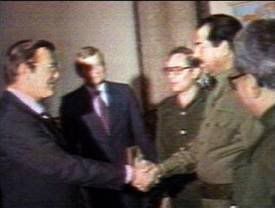
So Saddam Hussein has been found guilty of genocide against Kurds in 1982. Shock and surprise. How many of the 101st Fighting Keyboarders will now use that as justification for the Iraq War? Never mind that the US had no problem with Saddam's genocide at the time. That famous picture of Donald Rumsfeld shaking Saddam's hand took place about a year later, long after we knew full well what went down.
But what was the context of that picture?
One problem with using the Google to surf the internets is that there's relatively little hard info pre-1990 to be found. That's not too surprising, since few people knew what the internet was in 1990. After a session of cleaning out my basement however, I came across this gem, a Newsweek from January 2, 1984. On the Periscope page is a news snippet describing the meetings leading up to that handshake:
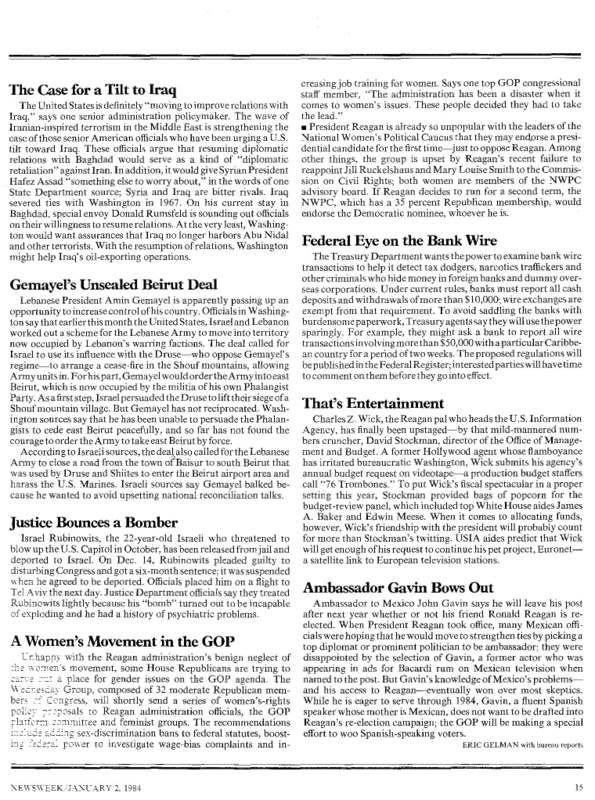
(Here's a jpg of the actual page for those lacking trust in my transcription skills.)"The Case for a Tilt to Iraq
The United States is definitely "moving to improve relations with Iraq," says one senior administration policymaker. The wave of Iranian-inspired terrorism in the Middle East is strengthening the case of those senior American officials who have been urging a U.S. Tilt toward Iraq. These officials argue that resuming diplomatic relations with Baghdad would serve as a kind of "diplomatic retaliation" against Iran. In addition, it would give Syrian President Hafez Assad "something else to worry about," in the words of one State Department source; Syria and Iraq are bitter rivals. Iraq severed ties with Washington in 1967. On his current stay in Baghdad, special envoy Donald Rumsfeld is sounding out officials on their willingness to resume relations. At the very least, Washington would want assurances that Iraq no longer harbors Abu Nidal and other terrorists. With the resumption of relations, Washington might help Iraq's oil exporting operations."
So we see clearly why Rumsfeld was for Saddam before he was against Saddam. How embarrassing for him, to be this wrong AND inconsistent at the same time. We also see that EVEN THEN it all revolved around oil, despite it being presented in an "oh by the way" tone in Newsweek.
Friday, September 15, 2006
Cheer up! Congress is on the Job!
Take a look at our intrepid House of Representatives Armed Services Committee web page.
They've got a plan for Iraq! In fact, they've got an organized "Victory In Iraq" Caucus all set up and working to ensure our... well... Victory in Iraq!
Scroll down the page a little to the "Victory In Iraq Caucus" link for further details on all the excitement! I don't know about you, but I feel SO much better. Tip of the hat to Atrios for spotting this.
The Iraq War: We Told You So.

All right, I've tried to resist this for a long time. I really didn't want to do it. Well actually, I did. Here goes:
We Told You So. We Were Right. You Were Wrong.
The Iraq War is a devastating, bankrupting, economy destroying disaster. Each time you fill your tank up with $2 to 3+ gasoline, remember that:
We Told You So. We Were Right. You Were Wrong.
You don't remember that we warned you before the Iraq invasion? Well on October 14, 2002, six months before the invasion, the group I've been involved with, Business Leaders for Sensible Priorities, ran a full page ad in the New York Times entitled "They're Selling War. We're Not Buying". The ad spoke of how the war was marketed like a new product, and suggested that warning labels be attached to that product: "Warning: War Will Wreck the Economy"; "Warning: War Will Breed Terrorism"; "Warning: War Will Discredit America in the World's Eyes" and "Warning: War Will Take A Terrible Toll in Human Life".
In March 2003, BLSP marshaled 7 Nobel Prize winning economists and scores of other businesspeople to sign another New York Times full page ad, this time highlighting the economic cost of a war with Iraq. The message:
"Which is smarter? Spending $80 million a year to disarm Iraq peaceably -- or spending a thousand times more on a war? In a time of economic peril, such a crushing "war surcharge" could only be justified by a clear threat to our nation. Iraq presents no such threat."On March 6, 2003 I had the opportunity to co-sign a letter to President Bush asking to speak with him concerning the economic consequences of war. That letter predicted lower stock prices, higher oil prices, lower consumer confidence, forced cuts in Federal state and local government programs, disrupted transportation, tourism and shipping and a backlash against American brands abroad. Of those predictions, all have come to pass at least somewhat except one: the stock market is higher than it was in 2003, partly fueled by huge gains in the defense and oil industries.
Of course, none of these ads and letters stopped the war from happening. BLSP didn't give up though. In March 2004 I had the privilege of representing BLSP in Washington unveiling a campaign kicked off by an ad in the New York Times signed by over 70 national business leaders titled: "Have you noticed what's happening to Chief Executives who lie?" and observed:
"We now know that the case the President made for his war was built almost entirely out of falsehoods."Later, after the devastation of Hurricane Katrina and the dysfunctional Federal response became obvious to all, again it was business leaders that connected the dots with the Iraq War's drain on our resources, observing:
"They died because the infrastructure of this great nation has been allowed to go to hell in favor of war in Iraq. They died because the National Guardsmen who could have saved lives were shipped off to that war.Now we see the result of this war. Cost estimates range in the trillions. Well over 2,600 American soldiers killed, as well as over 100,000 Iraqi civilians. Anti-American fervor is at a fever pitch in the Islamic world. We have lost all trace of respect and political capital in the world. We're generating hundreds of billions of new government debt owed to foreign governments largely as a result of this disaster. Oil is so expensive that when it drops below $70 per barrel, it's treated as good news. Sectarian violence and anarchy rules in Baghdad and elsewhere in Iraq. There were no weapons of mass destruction found, save some leftover spoiled canisters that the Reagan administration sold to Saddam in the 80's.
The myopia is mind-boggling. This very year hurricane protection projects around Lake Pontchartrain were slashed by 79%. Flood prevention projects in New Orleans took a 53% hit. The Corps of Engineers leader who complained was ousted. FEMA was gutted. Nothing not shaped like a Pentagon got adequate funding from this administration."
We Told You So.
If you're a businessperson, go join BLSP so the message can continue. If you're not a businessperson, go join their sister group True Majority. Enough is enough.
Sunday, November 27, 2005
If You Want to Cut Pork, Go to the Pentagon
(Here's the post I spoke of in my last entry.)
The Truth Laid Bear wants all good bloggers to support a bill put forth by a handful of conservative Republican Senators called "The Fiscal Watch Team Offset Package", This bill ostensibly offsets the costs of Hurricane Katrina with a bunch of Federal budget cuts to Medicare and a 5% reduction in all domestic spending. This is apparently a litmus test for bloggers and politicians alike. Support the bill with a specific declaration on your blog, and you are a "Porkbuster". Oppose the bill, and you favor profligate government waste. Faithful right-thinking bloggers are then supposed to declare their support on their blogs, to then be highlighted on the TTLB site. Look closer however, and the whole deal appears to be just another right wing attempt to frame opposition to domestic spending as "trimming wasteful pork".
I would like to say "I support the Fiscal Watch Team Offset Package", but I can't. It's a terrible, highly partisan bill that targets all the wrong areas and lets the main sources of government pork go untouched. This "package" would slash domestic spending across the board by 5%, increase Medicare costs and freeze COLA adjustments for non-military personnel. The recent pay hikes for Congressmen are not affected, nor are any military programs. This package is supposed to save $130 billion in 2 years. The fact that the Medicare savings don't accrue to the benefit of the Federal Budget (being an off-budget Trust Fund program) is apparently lost on our intrepid budget cutters.
 Well this is just balderdash. Most of the waste in government takes place in the military side of the ledger. In this chart, the red pie slice is the military's portion of all Federal discretionary spending. All, except for one important distinction: the Iraq and Afghanistan operations are funded by off budget emergency appropriations. What you see is the military budget minus our current wars du jour. So when our arch-conservative (and downright loopy) freshman Senator Tom Coburn (R, Mars) exempts all military spending from cuts, he's walking away from the biggest pie slice of all. Of course, that's intentional. The military is the Republicans' third rail, just as domestic spending such as Medicare and Social Security are the Democrats'. This bill therefore is merely a Trojan Horse partisan attack on the Democrats wrapped in anti-pork rhetoric.
If anyone is serious on Capitol Hill about reducing wasteful spending, you have to look at the Pentagon first. Defense Secretary Rumsfeld admitted in 2002 that the Pentagon has lost track of an estimated $2.3 trillion of military transactions. That's $2.3 trillion or over $8,000 for every man woman and child living in the USA. Contrast that with the $77 per person cost of pork identified in the Porkbusters database so far, and the $448 per person that Coburn's bill claims to save. And that before the Iraq War started, before Halliburton snagged those no bid contracts, before those untold billions were unaccounted for in the Iraq reconstruction budget. It's so bad, non-partisan tax watchdog Taxpayers for Common Sense said in 2003:
It's not just accounting incompetence though, it's deliberate policy decisions that waste hundreds of billions of dollars. Dr. Lawrence Korb, Asst Secy of Defense under Ronald Reagan, recently wrote a complete analysis of today's military programs. By targeting wasteful weapons systems designed to fight cold war enemies that no longer exist, he's found over $60 billion per year that could be cut from military budgets that actually would strengthen our national security.
Here's just one example from Korb's Report of the kind of unneeded pork we should cut: the V-22 Osprey program. This dog is a tilt rotor craft that takes off like a helicoptor and then flies like a plane. Or at least that's what it's supposed to do. Originally ordered in the 80's, it was dropped by the Army in the late 80's because of enormous technical problems and field test failures. Then-Sec'y of Defense Dick Cheney canceled the program in 1991. It was revived by Congress however and continued to live on in Pentagon budgets ever since. Several serious accidents in continued testing make the Osprey more deadly for our Armed Forces than the entire Kosovo War. The total cost of this dog is up to $50 billion. A little over $500 million was spent on payments to military contractors in FY2003, spread throughout two dozen different congressional districts. This dog should go before it kills any more Marines.
You want another piece of pork to dispense with? It's called "Operation Iraqi Freedom", an unforgiveable boondoggle that wastes $5.8 billion per month. That's $70 billion per year.
Follow Korb's advice on the traditional budget, and follow Congressman Murtha's advice on Iraq, and we'll have saved $260 billion over the next two years while actually strengthening military preparedness. That's twice what the Senator Coburn's package wants to slash, without snatching Medicare benefits from those who need them and slashing every domestic priority we have bedsides.
Dr. Korb presented the idea of his military cuts in October within days of Sen Coburn's Medicare and domestic cut package. But the TTLM "Porkbusters" effort apparently will have none of that. Only domestic programs are attacked in their database they've set up. Yet just that one Marine-killing Osprey program costs more than all of the pork identified in that database put together. So is "porkbusters" just a right wing framing campaign against domestic spending, or are they serious about actually trimming bigtime wasteful spending? It will be very interesting if Korb's recommendations ever makes it on the "Porkbusters" site.
The Truth Laid Bear wants all good bloggers to support a bill put forth by a handful of conservative Republican Senators called "The Fiscal Watch Team Offset Package", This bill ostensibly offsets the costs of Hurricane Katrina with a bunch of Federal budget cuts to Medicare and a 5% reduction in all domestic spending. This is apparently a litmus test for bloggers and politicians alike. Support the bill with a specific declaration on your blog, and you are a "Porkbuster". Oppose the bill, and you favor profligate government waste. Faithful right-thinking bloggers are then supposed to declare their support on their blogs, to then be highlighted on the TTLB site. Look closer however, and the whole deal appears to be just another right wing attempt to frame opposition to domestic spending as "trimming wasteful pork".
I would like to say "I support the Fiscal Watch Team Offset Package", but I can't. It's a terrible, highly partisan bill that targets all the wrong areas and lets the main sources of government pork go untouched. This "package" would slash domestic spending across the board by 5%, increase Medicare costs and freeze COLA adjustments for non-military personnel. The recent pay hikes for Congressmen are not affected, nor are any military programs. This package is supposed to save $130 billion in 2 years. The fact that the Medicare savings don't accrue to the benefit of the Federal Budget (being an off-budget Trust Fund program) is apparently lost on our intrepid budget cutters.
 Well this is just balderdash. Most of the waste in government takes place in the military side of the ledger. In this chart, the red pie slice is the military's portion of all Federal discretionary spending. All, except for one important distinction: the Iraq and Afghanistan operations are funded by off budget emergency appropriations. What you see is the military budget minus our current wars du jour. So when our arch-conservative (and downright loopy) freshman Senator Tom Coburn (R, Mars) exempts all military spending from cuts, he's walking away from the biggest pie slice of all. Of course, that's intentional. The military is the Republicans' third rail, just as domestic spending such as Medicare and Social Security are the Democrats'. This bill therefore is merely a Trojan Horse partisan attack on the Democrats wrapped in anti-pork rhetoric.
If anyone is serious on Capitol Hill about reducing wasteful spending, you have to look at the Pentagon first. Defense Secretary Rumsfeld admitted in 2002 that the Pentagon has lost track of an estimated $2.3 trillion of military transactions. That's $2.3 trillion or over $8,000 for every man woman and child living in the USA. Contrast that with the $77 per person cost of pork identified in the Porkbusters database so far, and the $448 per person that Coburn's bill claims to save. And that before the Iraq War started, before Halliburton snagged those no bid contracts, before those untold billions were unaccounted for in the Iraq reconstruction budget. It's so bad, non-partisan tax watchdog Taxpayers for Common Sense said in 2003:
"DOD is by far the most fiscally mismanaged agency. The GAO has said that overhauling the Pentagon's financial management will be a major challenge "that goes far beyond financial accounting to the very fiber of the department's business operations and management culture." In fact, no major part of DOD has ever passed an audit and the Pentagon readily admits that flawed business systems and practices are common within the agency. They claim it would take decades to get all of the agency books in order."
It's not just accounting incompetence though, it's deliberate policy decisions that waste hundreds of billions of dollars. Dr. Lawrence Korb, Asst Secy of Defense under Ronald Reagan, recently wrote a complete analysis of today's military programs. By targeting wasteful weapons systems designed to fight cold war enemies that no longer exist, he's found over $60 billion per year that could be cut from military budgets that actually would strengthen our national security.
Here's just one example from Korb's Report of the kind of unneeded pork we should cut: the V-22 Osprey program. This dog is a tilt rotor craft that takes off like a helicoptor and then flies like a plane. Or at least that's what it's supposed to do. Originally ordered in the 80's, it was dropped by the Army in the late 80's because of enormous technical problems and field test failures. Then-Sec'y of Defense Dick Cheney canceled the program in 1991. It was revived by Congress however and continued to live on in Pentagon budgets ever since. Several serious accidents in continued testing make the Osprey more deadly for our Armed Forces than the entire Kosovo War. The total cost of this dog is up to $50 billion. A little over $500 million was spent on payments to military contractors in FY2003, spread throughout two dozen different congressional districts. This dog should go before it kills any more Marines.
You want another piece of pork to dispense with? It's called "Operation Iraqi Freedom", an unforgiveable boondoggle that wastes $5.8 billion per month. That's $70 billion per year.
Follow Korb's advice on the traditional budget, and follow Congressman Murtha's advice on Iraq, and we'll have saved $260 billion over the next two years while actually strengthening military preparedness. That's twice what the Senator Coburn's package wants to slash, without snatching Medicare benefits from those who need them and slashing every domestic priority we have bedsides.
Dr. Korb presented the idea of his military cuts in October within days of Sen Coburn's Medicare and domestic cut package. But the TTLM "Porkbusters" effort apparently will have none of that. Only domestic programs are attacked in their database they've set up. Yet just that one Marine-killing Osprey program costs more than all of the pork identified in that database put together. So is "porkbusters" just a right wing framing campaign against domestic spending, or are they serious about actually trimming bigtime wasteful spending? It will be very interesting if Korb's recommendations ever makes it on the "Porkbusters" site.
Putting Porkbusters to the Test
In the aftermath of a wonderful Thanksgiving celebration, I was poking around the blogosphere and came across a growing site called "The Truth Laid Bear", which styles itself as a "fully developed portal to the blogosphere". It's pretty impressive too, with something like 7K visits per day and close to 50,000 blogs registered as part of the "TTLB Ecosystem". OK, so I registered my small blog with the group and was immediately branded an "Insignificant Microbe". Dudes, you might want to check with your publicist on the wisdom of that initial Out of the Box Experience. Subsequent scans by their software promoted me to "Slimy Mollusc". I feel so vindicated.
In any event it looks like a pretty nifty community to bop around in. One part of the site that drew my attention, being the hopeless would-be polysci wonk that I am, was a campaign called "Porkbusters". This brainchild of Instapundit is a great idea. It invites all bloggers to identify some particularly noisome example of government waste or pork and blog about it. We're also asked to pressure our Congresscritters to eliminate said pork forthwith. Porkbusters also promises to post each example on their site so that the whole community can share in the outrage.
Well I'm going to put this to the test. You see, the whole campaign appears to have a decidedly rightward tilt. Looking through the pork cited, all of it comes from domestic non military spending. Yet about 50% of the discretionary budget is devoted to the military, not including the Iraq and Afghanistan operations. My suspicions were confirmed by Porkbusters' highlighting of a right wing attempt to cut social programs, framed as the "Fiscal Watch Team Offset Package", an attempt to offset the expenses of cleaning up after Hurricanes Katrina and Rita.
So my next post will highlight some Pentagon pork. Let's see if the TTLB Ecosystem is up to including that in their efforts.
In any event it looks like a pretty nifty community to bop around in. One part of the site that drew my attention, being the hopeless would-be polysci wonk that I am, was a campaign called "Porkbusters". This brainchild of Instapundit is a great idea. It invites all bloggers to identify some particularly noisome example of government waste or pork and blog about it. We're also asked to pressure our Congresscritters to eliminate said pork forthwith. Porkbusters also promises to post each example on their site so that the whole community can share in the outrage.
Well I'm going to put this to the test. You see, the whole campaign appears to have a decidedly rightward tilt. Looking through the pork cited, all of it comes from domestic non military spending. Yet about 50% of the discretionary budget is devoted to the military, not including the Iraq and Afghanistan operations. My suspicions were confirmed by Porkbusters' highlighting of a right wing attempt to cut social programs, framed as the "Fiscal Watch Team Offset Package", an attempt to offset the expenses of cleaning up after Hurricanes Katrina and Rita.
So my next post will highlight some Pentagon pork. Let's see if the TTLB Ecosystem is up to including that in their efforts.
Sunday, October 30, 2005
GOP Senate to Workers: It's Fine to Be Paid 1/3rd Less Than Depression-Era Laborers
First, some perspective. Pictured here are some day laborers working on construction of the Hoover Dam in 1932.

These men were part of a corps of 5,000 men paid 50 cents an hour to do the dirty unskilled labor that created the magnificent dam over 5 years of hard dangerous work. Those who got that 50 cents an hour considered themselves lucky, as wage rates were depressed by the height of the Great Depression. Still, labor unions at the time bitterly denounced the wage rates and working conditions of the Hoover Dam laborers:
Now fast forward to 2005. The GOP dominated US Senate has just voted down the first increase of the minimum wage since 1997: from $5.15 to $6.25 an hour. All the Democrats plus four Republicans voted for it. It failed 51-49. In the time since the last increase in the minimum wage, Senators voted themselves seven pay raises totaling $28,000 per year.
What does this have to do with the Hoover Dam workers? Well, 50 cents an hour in the Depression translates into $7.89 per hour in today's dollars. (Don't believe me? Do the math with the historical Consumer Price Index.) What the Senate is saying is that today's minimum wage workers should be getting a wage 35% LOWER than unskilled, non-union labor in the height of the Great Depression. This is progress? No. It's a crime against Americans. Next election time, remember who did this to us.

These men were part of a corps of 5,000 men paid 50 cents an hour to do the dirty unskilled labor that created the magnificent dam over 5 years of hard dangerous work. Those who got that 50 cents an hour considered themselves lucky, as wage rates were depressed by the height of the Great Depression. Still, labor unions at the time bitterly denounced the wage rates and working conditions of the Hoover Dam laborers:
"We believe that a great injustice is being perpetrated against the workers at Boulder Dam in the general lowering of working and living conditions on a project directly under the supervision of our Government during this time of depression and unemployment. Labor at Boulder Dam has no voice in the settling of wages, hours of labor, working conditions, safety or living conditions. Last year local Labor Unions attempted to have the Bacon-Davis prevailing wage law apply to the Boulder Canyon project and Boulder City. An investigation by the conciliation Division of the Department of Labor found that the Bacon-Davis Act did not become a law until two days after the Six Companies signed their contract. Further, that reservations were not covered by the prevailing rate of wage law and the result was a general lowering of wages and working conditions. An arbitrary scale of wage was imposed on skilled mechanics twenty-five to fifty percent lower than the prevailing scales for similar work in the territory adjacent to the project."Picture and quote from the Boulder City/Hoover Dam Museum. Go there if you're in Vegas sometime. It's an incredible story they tell.
Now fast forward to 2005. The GOP dominated US Senate has just voted down the first increase of the minimum wage since 1997: from $5.15 to $6.25 an hour. All the Democrats plus four Republicans voted for it. It failed 51-49. In the time since the last increase in the minimum wage, Senators voted themselves seven pay raises totaling $28,000 per year.
What does this have to do with the Hoover Dam workers? Well, 50 cents an hour in the Depression translates into $7.89 per hour in today's dollars. (Don't believe me? Do the math with the historical Consumer Price Index.) What the Senate is saying is that today's minimum wage workers should be getting a wage 35% LOWER than unskilled, non-union labor in the height of the Great Depression. This is progress? No. It's a crime against Americans. Next election time, remember who did this to us.
Sunday, October 02, 2005
The Called Ball Didn't Fall: Bush Tax Cuts an Objective Failure
Reality is an inconvenient thing sometimes. In the polarized atmosphere of today's politics, reality is often hard to come by. Everyone has their spin, their set of facts and warping of same. Because of this, no one trusts what the other side is saying, and perhaps rightly so. That's why I like to get back to basics and simply rely on hard primary data that no one can dispute or question. So when a friend in another forum claimed that the Bush administration's tax cuts actually worked to foster economic growth and raise tax receipts (as reported by USA Today), I thought it was time to look at the facts.
When playing pool, the way players prevent one another from benefiting from lucky shots is to require each player to call what shot he/she is trying to make. If it happens, then fine. If something else happens, like the wrong ball falling into the wrong pocket, it doesn't count. The President's budget message to Congress each January is the fiscal politics version of calling your shots, though the administration would like us to forget this.
Each year the President's budget message contains five year projections of where the administration thinks revenues, spending and deficits will be. These projections are based upon the enactment of whatever tax and spending plan the President proposes with the message. So if a President suggests a bold new tax cut for example, the predicted effects of that tax cut are built into the numbers. What that means is that revisiting those numbers afterwards tells us if the predictions actually happened the way they predicted.
These numbers distill all of the spin, all the arguments, loaded catchphrases and sales slogans down to mathematical objective reality. In this case the numbers are produced and are sourced from the administration itself in a audited and vetted procedure that no one of either party has questioned for decades. So no one on either side of the aisle should be able to quibble with them.
In January 2002, after 9/11 and President Bush's first round of tax cuts, the administration suggested the rest of their major tax cuts and predicted a swift economic rebound. 9/11 was blamed for the deterioration of Federal finances leading to a $106 billion deficit projected in 2002, the first since 1997. Enacting the Bush plan for 2002 would
Those forecasts led to projects that by FY2004, economic growth would have been such to generate $2,175 billion in revenues. Offsetting that was $2,189 billion in spending, or a deficit of only $14 billion. Don't take my word for it. The Bush administration figures here are at the OMB's website in Excel, and Lotus 123.
Well 2004 has come and gone. The speeches are all done, the beans all counted. Here then is the REAL "No-Spin Zone". The final report on spending in 2004 comes to us in the President's budget message in January 2005. Bush reported that revenues came in at $1,880 billion, while spending was $2,292 billion.
Let's review. Actual revenues were $295 billion less than what the administration predicted would be the result of their economic growth and tax plan. They were off by almost 14%. They called their shot. The called ball didn't fall in the called pocket. Not even close. The period between prediction and outcome started AFTER 9/11 and ended BEFORE Katrina, so no excuses can be given for unforeseen events.
Now, Keynesian economics posits that raising deficit spending can sometimes jumpstart economic growth. Could any spending restraint by the administration have dampened growth during this time? Hardly. Bush administration projections called for them spending $2,189 billion a year by FY2004. Actual spending came in $103 billion MORE than what they had promised to do. No restraint there. The called ball didn't fall. Not even close.
So what of my friend who pointed to state government revenues as proof the tax cuts were working? Well, the Center for Budget and Policy Priorities looks at state government finances closer than any other public source I know. Their data suggests that this area is subject to immense political spin. Turns out State government finances are still in fiscal crisis, though deficits are beginning to shrink. In other words, the growth we are seeing now merely is catching up from the fall those revenues took in recent years. Further, many states are "decoupling" various tax deduction items found in Federal tax codes, a stealth tax increase raising state taxes without fanfare or much notice.
In other words, while state tax revenues might be rising, they signify nothing but an accidental ball falling into the pocket, uncalled by any player. It's just not relevant to answering the question of whether Bush's tax cuts are working. The called ball didn't fall. End of story.
When playing pool, the way players prevent one another from benefiting from lucky shots is to require each player to call what shot he/she is trying to make. If it happens, then fine. If something else happens, like the wrong ball falling into the wrong pocket, it doesn't count. The President's budget message to Congress each January is the fiscal politics version of calling your shots, though the administration would like us to forget this.
Each year the President's budget message contains five year projections of where the administration thinks revenues, spending and deficits will be. These projections are based upon the enactment of whatever tax and spending plan the President proposes with the message. So if a President suggests a bold new tax cut for example, the predicted effects of that tax cut are built into the numbers. What that means is that revisiting those numbers afterwards tells us if the predictions actually happened the way they predicted.
These numbers distill all of the spin, all the arguments, loaded catchphrases and sales slogans down to mathematical objective reality. In this case the numbers are produced and are sourced from the administration itself in a audited and vetted procedure that no one of either party has questioned for decades. So no one on either side of the aisle should be able to quibble with them.
In January 2002, after 9/11 and President Bush's first round of tax cuts, the administration suggested the rest of their major tax cuts and predicted a swift economic rebound. 9/11 was blamed for the deterioration of Federal finances leading to a $106 billion deficit projected in 2002, the first since 1997. Enacting the Bush plan for 2002 would
"...boost 2002 GDP growth by 0.5 percent and lead to the creation of 300,000 more jobs. The Administration has built its economic forecasts around the assumption that an economic stimulus package will be enacted."
Those forecasts led to projects that by FY2004, economic growth would have been such to generate $2,175 billion in revenues. Offsetting that was $2,189 billion in spending, or a deficit of only $14 billion. Don't take my word for it. The Bush administration figures here are at the OMB's website in Excel, and Lotus 123.
Well 2004 has come and gone. The speeches are all done, the beans all counted. Here then is the REAL "No-Spin Zone". The final report on spending in 2004 comes to us in the President's budget message in January 2005. Bush reported that revenues came in at $1,880 billion, while spending was $2,292 billion.
Let's review. Actual revenues were $295 billion less than what the administration predicted would be the result of their economic growth and tax plan. They were off by almost 14%. They called their shot. The called ball didn't fall in the called pocket. Not even close. The period between prediction and outcome started AFTER 9/11 and ended BEFORE Katrina, so no excuses can be given for unforeseen events.
Now, Keynesian economics posits that raising deficit spending can sometimes jumpstart economic growth. Could any spending restraint by the administration have dampened growth during this time? Hardly. Bush administration projections called for them spending $2,189 billion a year by FY2004. Actual spending came in $103 billion MORE than what they had promised to do. No restraint there. The called ball didn't fall. Not even close.
So what of my friend who pointed to state government revenues as proof the tax cuts were working? Well, the Center for Budget and Policy Priorities looks at state government finances closer than any other public source I know. Their data suggests that this area is subject to immense political spin. Turns out State government finances are still in fiscal crisis, though deficits are beginning to shrink. In other words, the growth we are seeing now merely is catching up from the fall those revenues took in recent years. Further, many states are "decoupling" various tax deduction items found in Federal tax codes, a stealth tax increase raising state taxes without fanfare or much notice.
In other words, while state tax revenues might be rising, they signify nothing but an accidental ball falling into the pocket, uncalled by any player. It's just not relevant to answering the question of whether Bush's tax cuts are working. The called ball didn't fall. End of story.
Sunday, September 11, 2005
Feds Were Not Always This Incompetent: The Response to Hurricane Marilyn
Will wonders never cease? A friend of mine pointed me to an article in the National Review criticizing the Bush Administration's response to Katrina. They were pretty enthusiastic. Unfortunately, they were blaming bureaucracy in general, as if the notion of a government agency included incompetence by definition, wrapping it up with: "Unfortunately, there is not much that can be done to make bureaucracy less bureaucratic."
You can excuse the NatReview for feeling this way. After all, conservatives spend all their time when they're out of power complaining how government doesn't work. Then when in power they spend all their time proving the point.
There is a way to make government work though. You have to want it to work. You have to give a damn about the mission you're about. Then, all things can be possible.
I was looking around to find out how well the Feds have responded to previous hurricanes and came across this excellent resource at the Quick Response Program and the Natural Hazards Center of the University of Colorado. That center reminded me of an excellent test case measuring the response of the Bush I and Clinton administrations to similar situations. In 1989
the Bush administration spearheaded relief efforts in the US Virgin Islands following Hurricane Hugo, while the Clinton administration relied on many of the same personnel and resources to respond to Hurricane Marilyn's USVI destruction six years later.
Quick Response Report #82 , written by Betty Hearn Morrow and A. Kathleen Ragsdale of the International Hurricane Center of Florida International University, reported on the response to Marilyn, with specific reference to comparing that response to Hugo. The Hugo response was very unsatisfactory:
Was the vastly quicker response to Katrina due to a much more talented force on the ground? No, most of the people involved were also involved with Hugo's response and could compare the two:
The Clinton administration responded much quicker, with humanitarian disaster relief in position in real time, offering much faster response to a devastating situation in St. Thomas. Because help was already there, looting by desperate people never happened.
Fast forward to Bush II's administration, which reverted to Bush I's pathetic too late and a dollar short response to Hugo. Once again the main initial concern was sending in the troops to stop looting, instead of disaster relief efforts. Once again help comes days too late.
The difference in these situations is that the Clinton administration WANTED to use government to make a difference for people. It's part and parcel to the Democratic Party ideology. The Republicans on the other hand have since Reagan wanted to shrink government down to a size small enough so that he could "drown it in a bathtub", as Grover Norquist famously said.
In a recent blog post I opined that right wingers were not qualified to run government, because their incompetence sprang from the simple fact that they hate their jobs, preferring to drown their jobs in a bathtub rather than execute them to the best of their ability. That blog post went up months ago. Unfortunately, Katrina just added a deadly exclamation point to the argument.
You can excuse the NatReview for feeling this way. After all, conservatives spend all their time when they're out of power complaining how government doesn't work. Then when in power they spend all their time proving the point.
There is a way to make government work though. You have to want it to work. You have to give a damn about the mission you're about. Then, all things can be possible.
I was looking around to find out how well the Feds have responded to previous hurricanes and came across this excellent resource at the Quick Response Program and the Natural Hazards Center of the University of Colorado. That center reminded me of an excellent test case measuring the response of the Bush I and Clinton administrations to similar situations. In 1989
the Bush administration spearheaded relief efforts in the US Virgin Islands following Hurricane Hugo, while the Clinton administration relied on many of the same personnel and resources to respond to Hurricane Marilyn's USVI destruction six years later.
Quick Response Report #82 , written by Betty Hearn Morrow and A. Kathleen Ragsdale of the International Hurricane Center of Florida International University, reported on the response to Marilyn, with specific reference to comparing that response to Hugo. The Hugo response was very unsatisfactory:
"In the aftermath of Hurricane Hugo, many St. Croix residents had expressed anger that the first federal planes to finally arrive several days after the storm carried troops armed with guns, not food and water, in what many felt was an overreaction to earlier looting reports (Morrow, 1992). There was a strong racial tone to the perception of many that the U.S. troops had arrived to protect white tourists from black locals, not to provide disaster assistance to the U.S. citizens of St. Croix, most of whom were people of color."The notion that a majority Black community had to wait several days for Federal relief efforts to arrive should have a familiar ring to it for anyone following the controversy of Federal response to Katrina in New Orleans. Even so, was that just a function of the remoteness of the Virgin Islands and the difficulty in mobilizing a large relief effort? Apparently not, as the Clinton administration's response to Marilyn was quite different:
"In anticipation of their need, a number of FEMA disaster specialists had been sent to St. Thomas before Hurricane Marilyn's landfall. By daybreak on September 16, relief supplies and personnel had already begun arriving (FEMA, 1995e). This was the first deployment of the new Federal Interagency/State Field Assessment Team designed to provide quick and technically accurate early damage assessments. According to their reports, St. Thomas received the heaviest impact - 80% of the homes were damaged, 40% were uninhabitable, and 20-30% of the businesses were destroyed (FEMA, 1995b, 1995c)...So all of this happened "within one week", meaning that much of the work was already done on the ground in the time that the Federal Katrina responders took to glom onto the fact that they needed to respond at all.
"Within one week after the storm, FEMA had directed close to 60 strategic missions transporting more than 1,500 emergency personnel and 1.3 million tons of essential cargo, including food, water, and plastic sheeting for roofs (FEMA, 1995a). Federal Coordinating Officer Dennis Kwiatkowski was quoted as saying, "We are pulling out all the stops in getting supplies down here to make recovery happen" (FEMA, 1995e). Five distribution sites were being operated by the Virgin Islands Territorial Emergency Management Agency (VITEMA) on St. Thomas. More than 2,100 federal agency personnel had been deployed. Four contracts had been awarded for immediate housing repairs. Dive teams had begun assessing infrastructural damage to the area's harbors and Navy Seabees had begun structural repairs to public buildings. Military and security forces included about 500 Army, Air Force, and Navy personnel, 500 National Guardsmen, and 500 federal law enforcement personnel (FEMA, 1995d). All major roads had been cleared, the St. Thomas airport was open for visual flight operations using a mobile air traffic control tower, and the St. Thomas Hospital was operational using generators for power."
Was the vastly quicker response to Katrina due to a much more talented force on the ground? No, most of the people involved were also involved with Hugo's response and could compare the two:
"Indeed one veteran FEMA reservist made these unsolicited remarks: "One thing that is noteworthy for your study, is that we seem to have had more active Army with weapons at Hugo. Here we have an adequate supply of federal marshals and they're doing a good job, but they [the military] were much more noticeable at Hugo. He had been one of the first FEMA workers to be sent to St. Croix after Hugo, which he attributed to having a military background. Yet, he stated, "I never felt one iota threatened on St. Croix . . . Other than the tension involved with going through one of these things [a hurricane], I found the people very helpful and honest." He had driven his rental car all over the island and was often helped when he lost his way. There was a general feeling that the atmosphere was more relaxed on St. ThomasSo the Bush I Administration waited several days before getting help to the victims of Hurricane Hugo. When help arrived the first response was to send in the army to stop looting.
and, yet, the recovery process was going a lot faster than it had six years earlier on St. Croix."
The Clinton administration responded much quicker, with humanitarian disaster relief in position in real time, offering much faster response to a devastating situation in St. Thomas. Because help was already there, looting by desperate people never happened.
Fast forward to Bush II's administration, which reverted to Bush I's pathetic too late and a dollar short response to Hugo. Once again the main initial concern was sending in the troops to stop looting, instead of disaster relief efforts. Once again help comes days too late.
The difference in these situations is that the Clinton administration WANTED to use government to make a difference for people. It's part and parcel to the Democratic Party ideology. The Republicans on the other hand have since Reagan wanted to shrink government down to a size small enough so that he could "drown it in a bathtub", as Grover Norquist famously said.
In a recent blog post I opined that right wingers were not qualified to run government, because their incompetence sprang from the simple fact that they hate their jobs, preferring to drown their jobs in a bathtub rather than execute them to the best of their ability. That blog post went up months ago. Unfortunately, Katrina just added a deadly exclamation point to the argument.
Friday, September 02, 2005
Hurricane Katrina: When the Alarm Bells Ring, Bush Hits the Snooze Button
At first blush it seems unfair to lay the disaster of Hurricane Katrina on George Bush's doorstep. After all, who can stop hurricanes from going wherever they want to go? However, the Bush administration, and the longer term policies of those who support the Bush administration, have a lot to do with how bad the carnage and destruction really are.
Failed: Protecting New Orleans from Flooding
First off, those levees did not have to have been breached. The Army Corps of Engineers has been working on shoring them up for some time, but they've been hampered by budget cuts through the years. The Southern Louisiana Urban Flood Control Project was started in 1995 under the Clinton administration. Over the years about $500 million of an estimated needed $750 million was spent shoring up levees. Under Bush, the money to complete the project was diverted in 2003, by pressures resulting from the Iraq war and the need for tax cuts for the rich.
Again, from Editor and Publisher:
Speaking of the war in Iraq, are you wondering why the government emergency response so far has been so tepid? While not denigrating the heroic efforts of those that ARE on the scene, I'm sure they would be a lot happier if so much of the Louisiana and Mississippi National Guard was there helping, instead of helplessly watching from Iraq.
Failed: Abandoning the Gulf Coast Poor
Lots of questions abound concerning why so many people didn't leave New Orleans beforehand. Well maybe that's because that the population of New Orleans is desperately poor and unable to hop into their handy Hummers or Esplanades to truck their way out to their summer homes. That might also explain the looting. When the infrastructure of civilization collapses all around you, you still have to eat, change the baby, take your medicine and survive.
New Orleans had a poverty rate in excess of 34% before the Bush administration came to town. Since then, the national poverty rate has climbed each and every year . Had there been a continuation of the Clinton administration's economic policies towards poverty, which reduced poverty by the largest degree in 30 years, it is likely that fewer people in New Orleans would have been in such vulnerable straits when Katrina hit. I tried to check New Orleans specific figures, but for some strange reason the New Orleans municipal web server isn't responding.
Failed: Where's the Proactive Government Response?
Speaking of all of that, there's a lot of talk about how ill-prepared the government response was, from the New York Times, "Waiting for a Leader" down to one citizen talking to the Chicago Sun Times comparing Fidel Castro's response to hurricane preparations versus the U.S. response.
Failed: Combating Global Warming and the Increasing Ferocity of Hurricanes
And finally, the big 800 pound elephant in the room. Fact is that just last month scientists at MIT nailed the connection between the increasing ferocity of hurricanes with global warming, specifically oceanic water temperatures. Years of global warming denial by Bush administration partisans and oil industry paid hacks have meant billions of tons of carbon dioxide warming the Earth that could have been ameliorated by now. Had we gotten to work on ratifying and implementing the Kyoto Treaty when we should have, that category 5 hurricane might have been a category 4 or 3 hurricane. That, as the people in the Gulf States are now painfully aware, makes a huge difference.
A concerned citizenry needs to respond. Over at the new NewOrleansJustice blog, there's a handy reference reminding us what the Constitutional duties of government officials are, naming names of those in charge of this unfolding catastrophe.
Failed: Protecting New Orleans from Flooding
First off, those levees did not have to have been breached. The Army Corps of Engineers has been working on shoring them up for some time, but they've been hampered by budget cuts through the years. The Southern Louisiana Urban Flood Control Project was started in 1995 under the Clinton administration. Over the years about $500 million of an estimated needed $750 million was spent shoring up levees. Under Bush, the money to complete the project was diverted in 2003, by pressures resulting from the Iraq war and the need for tax cuts for the rich.
Again, from Editor and Publisher:
"On June 8, 2004, Walter Maestri, emergency management chief for Jefferson Parish, Louisiana; told the Times-Picayune: "It appears that the money has been moved in the president's budget to handle homeland security and the war in Iraq, and I suppose that's the price we pay. Nobody locally is happy that the levees can't be finished, and we are doing everything we can to make the case that this is a security issue for us."Failed: Redirecting the National Guard Away from the Scene
Speaking of the war in Iraq, are you wondering why the government emergency response so far has been so tepid? While not denigrating the heroic efforts of those that ARE on the scene, I'm sure they would be a lot happier if so much of the Louisiana and Mississippi National Guard was there helping, instead of helplessly watching from Iraq.
Failed: Abandoning the Gulf Coast Poor
Lots of questions abound concerning why so many people didn't leave New Orleans beforehand. Well maybe that's because that the population of New Orleans is desperately poor and unable to hop into their handy Hummers or Esplanades to truck their way out to their summer homes. That might also explain the looting. When the infrastructure of civilization collapses all around you, you still have to eat, change the baby, take your medicine and survive.
New Orleans had a poverty rate in excess of 34% before the Bush administration came to town. Since then, the national poverty rate has climbed each and every year . Had there been a continuation of the Clinton administration's economic policies towards poverty, which reduced poverty by the largest degree in 30 years, it is likely that fewer people in New Orleans would have been in such vulnerable straits when Katrina hit. I tried to check New Orleans specific figures, but for some strange reason the New Orleans municipal web server isn't responding.
Failed: Where's the Proactive Government Response?
Speaking of all of that, there's a lot of talk about how ill-prepared the government response was, from the New York Times, "Waiting for a Leader" down to one citizen talking to the Chicago Sun Times comparing Fidel Castro's response to hurricane preparations versus the U.S. response.
"I detest Fidel Castro, but I will tell you this. When a hurricane is approaching Cuba, Castro has set up a system to bus everybody out of harm's way before disaster hits.The New Orleans Times-Picayune said on Tuesday:
"We knew the hurricane was going to hit New Orleans and Mississippi hard. Why didn't we send buses in to get the poor people out before disaster hit? We spend millions on recovery and rescue AFTERWARDS . . . when we could have alleviated so much death BEFORE?"
"No one can say they didn't see it coming. ... Now in the wake of one of the worst storms ever, serious questions are being asked about the lack of preparation."But of course, there's more. Turns out that on July 24 of this year, the Times-Picayune reported that government plans for evacuation of the poor began and ended with a DVD distributed throughout the city with the message that the poor were on their own if they needed to evacuate: From that Times-Picayune story (courtesy of Attytood at the Philadelphia Daily News)
"City, state and federal emergency officials are preparing to give the poorest of New Orleans' poor a historically blunt message: In the event of a major hurricane, you're on your own."Keep this callous laissez faire attitude in mind when you peruse this excellent Katrina timeline.
Failed: Combating Global Warming and the Increasing Ferocity of Hurricanes
And finally, the big 800 pound elephant in the room. Fact is that just last month scientists at MIT nailed the connection between the increasing ferocity of hurricanes with global warming, specifically oceanic water temperatures. Years of global warming denial by Bush administration partisans and oil industry paid hacks have meant billions of tons of carbon dioxide warming the Earth that could have been ameliorated by now. Had we gotten to work on ratifying and implementing the Kyoto Treaty when we should have, that category 5 hurricane might have been a category 4 or 3 hurricane. That, as the people in the Gulf States are now painfully aware, makes a huge difference.
A concerned citizenry needs to respond. Over at the new NewOrleansJustice blog, there's a handy reference reminding us what the Constitutional duties of government officials are, naming names of those in charge of this unfolding catastrophe.
Sunday, June 19, 2005
Today's Right Wingers are Unqualified for Government Service
Here's a challenge: Can anyone mention a single policy of George W. Bush's since he was installed as President that actually worked as advertised at the time? Anything? In any area?
Ever wonder why this question is so tough? I think the answer is so obvious that no one notices it: Modern Republican ideology hates government. When Ronald Reagan was President, he proclaimed that government wasn't for solving problems, government WAS the problem. When his budget director David Stockman wrote his famous mea culpa a few years later, he made it clear that "Reaganomics" was not a coherent economic plan, but merely a calculated scheme to "starve" government of resources to be able to do anything. Conservative boss Grover Norquist famously quipped that he wanted to shrink government down to a size small enough so that he could "drown it in a bathtub"
Can you think of any reason why anyone should expect success or even competence from anyone who hates the career endeavor they are in? Would you expect competence from a medical doctor who scoffs at the Hippocratic oath and thinks modern medical procedures are overkill and hooey? Would you entrust your home renovations to an electrician who thinks that building codes are evil and unnecessary? Would you trust your child's education to a teacher who wants to drown them in a bathtub?
Of course not.
Is there any reason why we should even expect competence from people who hate their jobs? When George Bush was running for President, he appeared to be blissfully unaware of basic matters of civics. Like castigating his opponents for wanting to run Social Security "like it's some kind of federal program". And it continues: From the President we hear that the Social Security Trust Fund is composed of "just IOU's", blissfully unaware that by describing Treasury Bonds as such, he violated the Constitution's 14th Amendment, an impeachable offense.
Once in power the right wing's incompetence continued of course. Allowing 9/11 to happen by aggressive neglect, at best. Demolishing the surplus and creating the largest deficits known to U.S. history. Putting the brakes on economic growth and jobs. Dismantling environmental protections. Rolling back the rights of working Americans. Demanding huge goals in education and refusing to fund the implementation of them. Trashing virtually every international treaty in operation. Bobbling the war in Afghanistan and turning it into the largest opium source in the world while allowing the Taliban back in to reorganize. Trashing our civil liberties. Manipulating our national science institutions for the benefit of corporate greed or weird religious extremist ends. And the final insult, the trumped up lies that enabled a totally fumbled, incompetently planned war on Iraq.
These are not the actions of a group who cares about government, about civics, about the health of the body politic and about America itself. These are the actions of the teacher who wants to drown kids in a bathtub, or a surgeon who thinks the Hippocratic Oath is nonsense.
A corollary to this idea is the fact that those who support the right side of the aisle share their leaders' distaste for all things government. Whether that distaste comes from personal convictions or the steady propaganda drip of the right wing media machine is subject to debate. Whatever the case is, no one can expect a person to devote much time learning about what is distasteful to him or her. So it should come as no surprise that those who have a distaste for government are those who know the least about its workings, policies and decisions. In the field, the ignorance of the workings of government by conservatives are way too numerous to mention. One characteristic example though is found in the rant of an otherwise apparently accomplished and intelligent blogger who recently argued that the U.S. Post Office would do far better if it relied not on taxes, but on user fees. This guy was apparently unaware that the USPS already does run on user fees. They're called "stamps".
The incompetent are leading the country with the support and grace of the ignorant. Be afraid. Be very afraid. People who hate what they do aren't qualified to remain in the profession they hate. Do them, and us, a favor and get them into another career path now!
Ever wonder why this question is so tough? I think the answer is so obvious that no one notices it: Modern Republican ideology hates government. When Ronald Reagan was President, he proclaimed that government wasn't for solving problems, government WAS the problem. When his budget director David Stockman wrote his famous mea culpa a few years later, he made it clear that "Reaganomics" was not a coherent economic plan, but merely a calculated scheme to "starve" government of resources to be able to do anything. Conservative boss Grover Norquist famously quipped that he wanted to shrink government down to a size small enough so that he could "drown it in a bathtub"
Can you think of any reason why anyone should expect success or even competence from anyone who hates the career endeavor they are in? Would you expect competence from a medical doctor who scoffs at the Hippocratic oath and thinks modern medical procedures are overkill and hooey? Would you entrust your home renovations to an electrician who thinks that building codes are evil and unnecessary? Would you trust your child's education to a teacher who wants to drown them in a bathtub?
Of course not.
Is there any reason why we should even expect competence from people who hate their jobs? When George Bush was running for President, he appeared to be blissfully unaware of basic matters of civics. Like castigating his opponents for wanting to run Social Security "like it's some kind of federal program". And it continues: From the President we hear that the Social Security Trust Fund is composed of "just IOU's", blissfully unaware that by describing Treasury Bonds as such, he violated the Constitution's 14th Amendment, an impeachable offense.
Once in power the right wing's incompetence continued of course. Allowing 9/11 to happen by aggressive neglect, at best. Demolishing the surplus and creating the largest deficits known to U.S. history. Putting the brakes on economic growth and jobs. Dismantling environmental protections. Rolling back the rights of working Americans. Demanding huge goals in education and refusing to fund the implementation of them. Trashing virtually every international treaty in operation. Bobbling the war in Afghanistan and turning it into the largest opium source in the world while allowing the Taliban back in to reorganize. Trashing our civil liberties. Manipulating our national science institutions for the benefit of corporate greed or weird religious extremist ends. And the final insult, the trumped up lies that enabled a totally fumbled, incompetently planned war on Iraq.
These are not the actions of a group who cares about government, about civics, about the health of the body politic and about America itself. These are the actions of the teacher who wants to drown kids in a bathtub, or a surgeon who thinks the Hippocratic Oath is nonsense.
A corollary to this idea is the fact that those who support the right side of the aisle share their leaders' distaste for all things government. Whether that distaste comes from personal convictions or the steady propaganda drip of the right wing media machine is subject to debate. Whatever the case is, no one can expect a person to devote much time learning about what is distasteful to him or her. So it should come as no surprise that those who have a distaste for government are those who know the least about its workings, policies and decisions. In the field, the ignorance of the workings of government by conservatives are way too numerous to mention. One characteristic example though is found in the rant of an otherwise apparently accomplished and intelligent blogger who recently argued that the U.S. Post Office would do far better if it relied not on taxes, but on user fees. This guy was apparently unaware that the USPS already does run on user fees. They're called "stamps".
The incompetent are leading the country with the support and grace of the ignorant. Be afraid. Be very afraid. People who hate what they do aren't qualified to remain in the profession they hate. Do them, and us, a favor and get them into another career path now!
Monday, March 07, 2005
How to Create A Crisis Out of Thin Air: Cooking the Social Security Numbers
Now let’s see. If I wanted to create a scenario where the long term collapse of Social Security would happen, how would I have to construct my economic models to predict such a collapse?
Well since good economic growth will keep the system solvent for the next century or so, I’d have to erase that average annual 3.3% real GDP growth the USA worked hard to earn over the last 40 years. What would do it? So, we’ll just slice GDP growth by 12% now and see how that looks on the spreadsheet. When that didn’t do the job, we’ll just keep on slashing it until over time annual GDP growth is just about half as much as it is today.
But how do we justify that? Well we’ll just slice 10% off the nation’s fertility rate, and then slash the productivity growth rate we enjoy today by over 50% over time. Now despite the fact that the Center for Immigration Studies estimates that 1.3 million immigrants settle in the country each year, let’s just magically reduce that by 30% over time as well. Let’s see what else...?
Oh yes! We’ll just hike up assumed inflation by 17%, from (2.3% today to 2.8% over time). Will people notice that inflation will hardly increase if our economic growth rate is heading the other way? Who cares? Nobody reads these reports beyond the executive summary anyway.
For good measure, we can assume that future unemployment rates will be 10% above the current 10 year average rate of 5.05%. We’ll be safe with THAT assumption, since the Bush administration is doing such a lovely job making that come true.
Well, let’s press F9 and recalculate this spreadsheet and see what we’ve got. Woo hoo! We did it! We now have projected that Social Security will have to pay out more benefits than it has in it's bank account or takes in with taxes 37 years from now! What’s that you say? That’s happened several times before (14 times before, according to the SSA) and the sky didn’t fall? OK, so we present it to the public as 2042 is the year when Social Security will "be flat broke"!
Now what do we do with the other projection we started from? You know, the one with the economic assumptions pretty much in line with what reality has been showing for the last few decades or so? The one that shows that Social Security never runs out of money over the entire time we study, even if we do absolutely nothing to change the system? (See Option I in the Trustee’s Graph below.)
Figure IV.B3.--Long-Range OASI and DI Trust Fund Ratios
[Assets as a percentage of annual expenditures]
from The 2004 OASDI Trustees Report

I know! We’ll call the projection with the realistic assumptions the optimistic "low cost" projection. Then we’ll call our doctored pessimistic version the "intermediate cost" version. We’ll go back to the drawing board and slash immigration rates another 18%, hike up unemployment rates another 18%, drop our fertility rate another 13%, hike up inflation yet another 35%, and lower GDP another big chunk by imagining two recessions and a longer term reduction in GDP growth by another 25%.
Never mind that sustained slow growth and two recessions with simultaneous sustained increased inflation is virtually impossible. What’s important is the first arbitrarily pessimistic scenario will look moderate by comparison. That "intermediate" projection will be the one pundits will use to point to the troubles of Social Security. Even progressives will buy into the idea that we’ll have to do SOMETHING to ‘fix’ Social Security. And that something will happen now, when the right wingers still have control over every branch of government and thus ensure that whatever change happens will be to the right wingers’ liking.
This scenario is not a conjecture. This is exactly what’s happened. The numbers used above come directly from the 2004 Social Security Trustees Report everyone is misquoting and their little noticed chapters describing how they constructed their scenarios. My argument is not necessarily with the policy wonks producing the Trustees’ Report. Sound financial managers can and should examine worst case scenarios in projecting the long term health of funds they are stewards for. My argument is with the politicization of the reports, morphing worst case scenarios into inevitable crises. No one does that unless (1) they are too incompetent to know what they are reading, or (2) they wish to deliberately lie to the public. Either is an impeachable offense in my opinion. Don’t let them destroy Social Security.
Well since good economic growth will keep the system solvent for the next century or so, I’d have to erase that average annual 3.3% real GDP growth the USA worked hard to earn over the last 40 years. What would do it? So, we’ll just slice GDP growth by 12% now and see how that looks on the spreadsheet. When that didn’t do the job, we’ll just keep on slashing it until over time annual GDP growth is just about half as much as it is today.
But how do we justify that? Well we’ll just slice 10% off the nation’s fertility rate, and then slash the productivity growth rate we enjoy today by over 50% over time. Now despite the fact that the Center for Immigration Studies estimates that 1.3 million immigrants settle in the country each year, let’s just magically reduce that by 30% over time as well. Let’s see what else...?
Oh yes! We’ll just hike up assumed inflation by 17%, from (2.3% today to 2.8% over time). Will people notice that inflation will hardly increase if our economic growth rate is heading the other way? Who cares? Nobody reads these reports beyond the executive summary anyway.
For good measure, we can assume that future unemployment rates will be 10% above the current 10 year average rate of 5.05%. We’ll be safe with THAT assumption, since the Bush administration is doing such a lovely job making that come true.
Well, let’s press F9 and recalculate this spreadsheet and see what we’ve got. Woo hoo! We did it! We now have projected that Social Security will have to pay out more benefits than it has in it's bank account or takes in with taxes 37 years from now! What’s that you say? That’s happened several times before (14 times before, according to the SSA) and the sky didn’t fall? OK, so we present it to the public as 2042 is the year when Social Security will "be flat broke"!
Now what do we do with the other projection we started from? You know, the one with the economic assumptions pretty much in line with what reality has been showing for the last few decades or so? The one that shows that Social Security never runs out of money over the entire time we study, even if we do absolutely nothing to change the system? (See Option I in the Trustee’s Graph below.)
Figure IV.B3.--Long-Range OASI and DI Trust Fund Ratios
[Assets as a percentage of annual expenditures]
from The 2004 OASDI Trustees Report
I know! We’ll call the projection with the realistic assumptions the optimistic "low cost" projection. Then we’ll call our doctored pessimistic version the "intermediate cost" version. We’ll go back to the drawing board and slash immigration rates another 18%, hike up unemployment rates another 18%, drop our fertility rate another 13%, hike up inflation yet another 35%, and lower GDP another big chunk by imagining two recessions and a longer term reduction in GDP growth by another 25%.
Never mind that sustained slow growth and two recessions with simultaneous sustained increased inflation is virtually impossible. What’s important is the first arbitrarily pessimistic scenario will look moderate by comparison. That "intermediate" projection will be the one pundits will use to point to the troubles of Social Security. Even progressives will buy into the idea that we’ll have to do SOMETHING to ‘fix’ Social Security. And that something will happen now, when the right wingers still have control over every branch of government and thus ensure that whatever change happens will be to the right wingers’ liking.
This scenario is not a conjecture. This is exactly what’s happened. The numbers used above come directly from the 2004 Social Security Trustees Report everyone is misquoting and their little noticed chapters describing how they constructed their scenarios. My argument is not necessarily with the policy wonks producing the Trustees’ Report. Sound financial managers can and should examine worst case scenarios in projecting the long term health of funds they are stewards for. My argument is with the politicization of the reports, morphing worst case scenarios into inevitable crises. No one does that unless (1) they are too incompetent to know what they are reading, or (2) they wish to deliberately lie to the public. Either is an impeachable offense in my opinion. Don’t let them destroy Social Security.
Wednesday, January 26, 2005
A Side Note on the Insanity of Right Wing Politics...
Reflecting the seriousness and sober reflection undertaken by the right wing on Social Security, a coalition of conservative groups known collectively as the Arlington Group, is telling Karl Rove that they won't go along with the administration's Social Security destruction plans unless the Bush administration puts just as much emphasis on banning gay marriages.
Huh?
Never mind the total cognitive disconnect and non-relationship between state civil marriage laws and the Social Security program. Look at what our conservative guardians of family values are really saying here:
Huh?
Never mind the total cognitive disconnect and non-relationship between state civil marriage laws and the Social Security program. Look at what our conservative guardians of family values are really saying here:
"Let's make a deal. We'll help push for the Federal Government to take away trillions of future retirement benefits for us and our families in return for you pushing to let the Federal Government dictate who we can and can't marry."These people don't need a voice in government. They need a soft room and the kindly attention of a very large and compassionate medical staff.
Tuesday, December 14, 2004
It's a Social Program, Not a 401(k)!!
Number three in a continuing series.
Myth #4: Social Security is a pension or an insurance plan. (Reality: Social Security is a social program, the only social program that is so well funded and secure that it will not need a dime of additional Federal taxes for decades.)
We often hear of Social Security as a pension plan or an insurance plan. Comparing Social Security to private employer pension plans gives rise to a number of misleading and alarming observations about Social Security’s desirability. First and foremost is the charge that the individual worker gets a bad investment deal out of the system. My favorite barking mad Libertarian P.J. O’Rourke offers the typical argument:
Myth #4: Social Security is a pension or an insurance plan. (Reality: Social Security is a social program, the only social program that is so well funded and secure that it will not need a dime of additional Federal taxes for decades.)
We often hear of Social Security as a pension plan or an insurance plan. Comparing Social Security to private employer pension plans gives rise to a number of misleading and alarming observations about Social Security’s desirability. First and foremost is the charge that the individual worker gets a bad investment deal out of the system. My favorite barking mad Libertarian P.J. O’Rourke offers the typical argument:
"And if we're age twenty-four to sixty-two, we can expect a return of between -0.34 percent and -1.7 percent, and might be better off leaving the money in our old jeans and going through the closet when we retire."
Then there’s the "Ponzi Scheme" charge, named after the famous swindler who offered big dividends to investors, paid for by the investment of newer investors. Here’s O’Rourke again in the same article:
"Charles Ponzi made a profit on this, and so does the U.S. government. Social Security payroll-tax receipts have always been greater than Social Security benefit payments and will continue to be until about 2013, when the baby-boom sucker pool retires. The federal government has taken this surplus revenue, spent it and given the Social Security trust-fund IOUs in return."
(SIDE NOTE: I urge people to read O’Rourke’s article. See how many logical fallacies and statements of objective falsehood you can find. I’ve found 37 so far.)
These arguments would be more persuasive if Social Security was in fact a pension or insurance plan or a 401(k). But it's not any of those. It’s not a personal investment. It’s a government social program that happens to be funded largely through a special levy of payroll tax. Don’t believe me? I don’t blame%2
Monday, November 15, 2004
Dispelling Social Security Myths
Oh boy, here we go again.
The alarm bells about the long term safety of Social Security have started anew. After basically keeping mum on the subject in the campaign, the Bush Administration is emboldened by their 51% victory to try once again to "fix" Social Security.
Nowhere in political discourse is there more deliberate misinformation than in the Social Security debate. Nowhere is it more obvious that politicians on both sides have a fundamental misunderstanding on the basic facts of the issue. It's more than a little scary. So over time, I'm going to lend my small effort to dispel some of the more important myths about Social Security. After we're done, it should be plain to see what to do about the system: Leave it alone!
Here are the topics I'll be addressing:
Myth #1: Social Security is in trouble and will go bankrupt when all those baby boomers retire. Therefore we must fix it before that happens. (Reality: Social Security won't run out of funds at all -- ever -- if we simply maintain the level of economic growth we are experiencing right now.)
Myth #2: The Social Security Trust Funds don't really exist except as an accounting fiction. (Reality: The Trust Funds are definitely real, with real assets far above the credit quality and safety of any bank or insurance company in the world.)
Myth #3: Politicians often "raid" the Trust Funds to pay for other Federal budget needs. (Reality: The Trust Funds pay for no other programs except what they are charged to do. Not a penny has been spent from their operating budgets for any other program ...ever.)
Myth #4: Social Security is a pension or an insurance plan. (Reality: Social Security is a social program, the only social program that is so well funded and secure that it will not need a dime of additional Federal taxes for decades.)
Myth #5: Medicare is broken and needs to be fixed. (Reality: It is the nation's health care system that needs to be fixed, not Medicare.)
Myth #6: Social Security is a drag on the economy. (Reality: Social Security has been a mighty engine for U.S. economic growth in several different ways.)
And now to begin with #1:
Myth #1: Social Security is in trouble and will go bankrupt when all those baby boomers retire. Therefore we must fix it before that happens.
Here of course, the term "fix" is to be used in the same context as "fixing" your pet. For Social Security does not need to be saved. It is not broken. Why do I say that Social Security isn't in trouble when every talking head and pundit talks about Social Security's crisis 24/7?
You've all heard the argument. The massive number of baby boomers will all retire in a short while, leaving fewer and fewer workers to support more and more retirees in the SS system until it all goes bankrupt in a few decades. In the latest Social Security Trustees Report, the Trustees have crunched their numbers and forecasted when that day will come:
"Despite these cash-flow deficits, beginning in 2018, redemption of trust fund assets will allow continuation of full benefit payments on a timely basis until 2042, when the trust funds will become exhausted."
How do they arrive at this scenario? The Trustees use computer models simulating the U.S. economy, fertility and immigration rates, inflation, interest rates and so forth. Then they run three simulations based on pessimistic, optimistic and intermediate assumptions of average levels for all of these factors. The intermediate model is the one picked for the press releases, being the Social Security Trustees best estimate of things to come. Sounds reasonable so far.
However, the devil is in the details. Any computer simulation is only as good as the assumptions you enter. In this case however, the assumptions are too pessimistic. Here you can find the assumptions used in 2004's projections.
Now I'm no expert on fertility rates and such, but I can say for sure that the range of total productivity rates assumed by the modeling are too conservative. The best case scenario calls for 1.9% productivity growth. The worst case calls for 1.3% and the intermediate projection is 1.6% per year.
The problem is that average annual productivity growth over the last 50 years is 2.16%. That's right, not even the most optimistic scenario examined by Social Security so much as assumes the same productivity growth rate we've enjoyed for 50 years. (Caveat: I'm using output per hour for non-farm businesses, the standard measure of productivity provided by the Bureau of Labor Statistics. Here's where you can construct the table. The Social Security Trustees explain that they do not use this commonly accepted measure in their projections. Rather they use an unpublished compilation of man/hour statistics provided to them by the BLS. Therefore their work is not easily duplicated.)
This assumption has a huge impact on the health of the trust funds. Less productivity growth means lower economic growth, which means fewer jobs and/or lower salaries paying into the system over the years, meaning the Trust Funds fall short sooner rather than later. And, as noted above, the Trust Funds run out of excess cash in 2042 under their 1.6% growth scenario.
What this also means is that for each year productivity grows more than 1.6%, the Trust Funds will look healthier than they did the year before as additional growth not predicted by the models would be booked in to the new projections. And sure enough, that's exactly what's happened.
Looking at the history of these projections, we see continual readjustments forward as we continue to grow more than the Trustees are calculating.
In 2003, after a lackluster 2002, the Trustees predicted 2042 as well to be the day the Trust Funds run dry: "Despite these cash-flow deficits, trust fund interest earnings and assets will allow continuation of full benefit payments until 2042, when the trust funds will be exhausted."
In 2002's Report, the year was 2041: "...asset redemptions begin to reduce the size of the combined trust funds in 2027, and the assets of the combined OASI and DI Trust Funds are exhausted in 2041."
In 2001's Report, the deadline was set at 2038: "...asset redemptions begin to reduce the size of the combined trust funds in 2025, and the assets of the combined OASI and DI Trust Funds are exhausted in 2038."
In 2000's Report, the deadline was 2037: "The combined OASI and DI Trust Funds would become exhausted in 2037 without corrective legislation."
And in 1999's Report the day of reckoning comes in 2034: "The combined OASI and DI Trust Funds would become exhausted in 2034 without corrective legislation."
In 1998 the Trust Funds were to go broke in 2032: "The combined OASI and DI Trust Funds would become exhausted in 2032 without corrective legislation."
And in 1997 the Trust Funds were to go dry in 2029: "The combined OASI and DI Trust Funds would become exhausted in 2029 without corrective legislation."
So, the Social Security doomsayers were screaming in 1997: "It's going to go broke in 32 years unless we do something!" Today, the doomsayers are screaming "It's going to go broke in 38 years unless we do something!"
Well, we've done nothing in the intervening time. No drastic reform. No overhaul. No additional cash infusion. Simply by growing GDP and productivity at the pace we've been doing for decades grows us out of the problem. Seven years of average growth bought us an additional 13 years before the Trust Funds would go broke.
This then is the fix for Social Security: maintaining a reasonable pro-growth economy which grows productivity. The Trustees Report "optimistic" scenario shows that if we maintain productivity growth of 1.9%, the Trust Funds never run out of money for the entire 75 year period studied. (Caveat #2: Yes there are other factors besides Productivity in the optimistic model, some controllable by legislation. For example, immigration assumptions are a net inflow of 900,000 per year. Yet the INS estimates that 13.5 million immigrants came to this country in the 90's, legal and illegal. Bring them all in the Social Security system and we've expanded the total per year beyond Social Security's most optimistic estimates without changing the actual number of immigrants at all.)
Now some may argue that we should plan for the most pessimistic scenarios and assume the worst will happen - in this case that productivity growth will somehow slow by 25% or more. That's a fine argument, except that if productivity was going to slow down to that drastic a degree, the LAST thing you would want to do is invest in the stock market, which depends on ever increasing productivity. So the notion of privatizing Social Security to cash in on stock market growth makes no sense however you look at it. If we have decent enough growth to make stock market investments look attractive, the Social Security system will be secure and in no need of change. If economic conditions were to be bad enough to endanger Social Security, then stock market investments should fare even worse.
While politicians themselves may be clueless, any professional policy wonk in Washington knows these facts. The political manipulation of the Trust Funds' conservative estimates are well known inside the beltway. The people scaring you into thinking Social Security won't be there for you when you retire, UNLESS they get their way to alter the system in a FUBAR kind of way, are people who know they are lying to you. They are lying to you because they know they can't get rid of the Social Security program in honest debate due to the program's popularity. So they lie to you, saying it's a flawed system bound to fail unless they "rescue" it. Don't let them do it. Don't let them hijack Social Security and destroy the most successful social program in the history of the Republic.
The alarm bells about the long term safety of Social Security have started anew. After basically keeping mum on the subject in the campaign, the Bush Administration is emboldened by their 51% victory to try once again to "fix" Social Security.
Nowhere in political discourse is there more deliberate misinformation than in the Social Security debate. Nowhere is it more obvious that politicians on both sides have a fundamental misunderstanding on the basic facts of the issue. It's more than a little scary. So over time, I'm going to lend my small effort to dispel some of the more important myths about Social Security. After we're done, it should be plain to see what to do about the system: Leave it alone!
Here are the topics I'll be addressing:
Myth #1: Social Security is in trouble and will go bankrupt when all those baby boomers retire. Therefore we must fix it before that happens. (Reality: Social Security won't run out of funds at all -- ever -- if we simply maintain the level of economic growth we are experiencing right now.)
Myth #2: The Social Security Trust Funds don't really exist except as an accounting fiction. (Reality: The Trust Funds are definitely real, with real assets far above the credit quality and safety of any bank or insurance company in the world.)
Myth #3: Politicians often "raid" the Trust Funds to pay for other Federal budget needs. (Reality: The Trust Funds pay for no other programs except what they are charged to do. Not a penny has been spent from their operating budgets for any other program ...ever.)
Myth #4: Social Security is a pension or an insurance plan. (Reality: Social Security is a social program, the only social program that is so well funded and secure that it will not need a dime of additional Federal taxes for decades.)
Myth #5: Medicare is broken and needs to be fixed. (Reality: It is the nation's health care system that needs to be fixed, not Medicare.)
Myth #6: Social Security is a drag on the economy. (Reality: Social Security has been a mighty engine for U.S. economic growth in several different ways.)
And now to begin with #1:
Myth #1: Social Security is in trouble and will go bankrupt when all those baby boomers retire. Therefore we must fix it before that happens.
Here of course, the term "fix" is to be used in the same context as "fixing" your pet. For Social Security does not need to be saved. It is not broken. Why do I say that Social Security isn't in trouble when every talking head and pundit talks about Social Security's crisis 24/7?
You've all heard the argument. The massive number of baby boomers will all retire in a short while, leaving fewer and fewer workers to support more and more retirees in the SS system until it all goes bankrupt in a few decades. In the latest Social Security Trustees Report, the Trustees have crunched their numbers and forecasted when that day will come:
"Despite these cash-flow deficits, beginning in 2018, redemption of trust fund assets will allow continuation of full benefit payments on a timely basis until 2042, when the trust funds will become exhausted."
How do they arrive at this scenario? The Trustees use computer models simulating the U.S. economy, fertility and immigration rates, inflation, interest rates and so forth. Then they run three simulations based on pessimistic, optimistic and intermediate assumptions of average levels for all of these factors. The intermediate model is the one picked for the press releases, being the Social Security Trustees best estimate of things to come. Sounds reasonable so far.
However, the devil is in the details. Any computer simulation is only as good as the assumptions you enter. In this case however, the assumptions are too pessimistic. Here you can find the assumptions used in 2004's projections.
Now I'm no expert on fertility rates and such, but I can say for sure that the range of total productivity rates assumed by the modeling are too conservative. The best case scenario calls for 1.9% productivity growth. The worst case calls for 1.3% and the intermediate projection is 1.6% per year.
The problem is that average annual productivity growth over the last 50 years is 2.16%. That's right, not even the most optimistic scenario examined by Social Security so much as assumes the same productivity growth rate we've enjoyed for 50 years. (Caveat: I'm using output per hour for non-farm businesses, the standard measure of productivity provided by the Bureau of Labor Statistics. Here's where you can construct the table. The Social Security Trustees explain that they do not use this commonly accepted measure in their projections. Rather they use an unpublished compilation of man/hour statistics provided to them by the BLS. Therefore their work is not easily duplicated.)
This assumption has a huge impact on the health of the trust funds. Less productivity growth means lower economic growth, which means fewer jobs and/or lower salaries paying into the system over the years, meaning the Trust Funds fall short sooner rather than later. And, as noted above, the Trust Funds run out of excess cash in 2042 under their 1.6% growth scenario.
What this also means is that for each year productivity grows more than 1.6%, the Trust Funds will look healthier than they did the year before as additional growth not predicted by the models would be booked in to the new projections. And sure enough, that's exactly what's happened.
Looking at the history of these projections, we see continual readjustments forward as we continue to grow more than the Trustees are calculating.
In 2003, after a lackluster 2002, the Trustees predicted 2042 as well to be the day the Trust Funds run dry: "Despite these cash-flow deficits, trust fund interest earnings and assets will allow continuation of full benefit payments until 2042, when the trust funds will be exhausted."
In 2002's Report, the year was 2041: "...asset redemptions begin to reduce the size of the combined trust funds in 2027, and the assets of the combined OASI and DI Trust Funds are exhausted in 2041."
In 2001's Report, the deadline was set at 2038: "...asset redemptions begin to reduce the size of the combined trust funds in 2025, and the assets of the combined OASI and DI Trust Funds are exhausted in 2038."
In 2000's Report, the deadline was 2037: "The combined OASI and DI Trust Funds would become exhausted in 2037 without corrective legislation."
And in 1999's Report the day of reckoning comes in 2034: "The combined OASI and DI Trust Funds would become exhausted in 2034 without corrective legislation."
In 1998 the Trust Funds were to go broke in 2032: "The combined OASI and DI Trust Funds would become exhausted in 2032 without corrective legislation."
And in 1997 the Trust Funds were to go dry in 2029: "The combined OASI and DI Trust Funds would become exhausted in 2029 without corrective legislation."
So, the Social Security doomsayers were screaming in 1997: "It's going to go broke in 32 years unless we do something!" Today, the doomsayers are screaming "It's going to go broke in 38 years unless we do something!"
Well, we've done nothing in the intervening time. No drastic reform. No overhaul. No additional cash infusion. Simply by growing GDP and productivity at the pace we've been doing for decades grows us out of the problem. Seven years of average growth bought us an additional 13 years before the Trust Funds would go broke.
This then is the fix for Social Security: maintaining a reasonable pro-growth economy which grows productivity. The Trustees Report "optimistic" scenario shows that if we maintain productivity growth of 1.9%, the Trust Funds never run out of money for the entire 75 year period studied. (Caveat #2: Yes there are other factors besides Productivity in the optimistic model, some controllable by legislation. For example, immigration assumptions are a net inflow of 900,000 per year. Yet the INS estimates that 13.5 million immigrants came to this country in the 90's, legal and illegal. Bring them all in the Social Security system and we've expanded the total per year beyond Social Security's most optimistic estimates without changing the actual number of immigrants at all.)
Now some may argue that we should plan for the most pessimistic scenarios and assume the worst will happen - in this case that productivity growth will somehow slow by 25% or more. That's a fine argument, except that if productivity was going to slow down to that drastic a degree, the LAST thing you would want to do is invest in the stock market, which depends on ever increasing productivity. So the notion of privatizing Social Security to cash in on stock market growth makes no sense however you look at it. If we have decent enough growth to make stock market investments look attractive, the Social Security system will be secure and in no need of change. If economic conditions were to be bad enough to endanger Social Security, then stock market investments should fare even worse.
While politicians themselves may be clueless, any professional policy wonk in Washington knows these facts. The political manipulation of the Trust Funds' conservative estimates are well known inside the beltway. The people scaring you into thinking Social Security won't be there for you when you retire, UNLESS they get their way to alter the system in a FUBAR kind of way, are people who know they are lying to you. They are lying to you because they know they can't get rid of the Social Security program in honest debate due to the program's popularity. So they lie to you, saying it's a flawed system bound to fail unless they "rescue" it. Don't let them do it. Don't let them hijack Social Security and destroy the most successful social program in the history of the Republic.
Sunday, November 07, 2004
A Mandate? Not So Fast!
President Bush and his supporters are unabashedly crowing over their victory on election day. That's fine. They won. They step over the line when they claim a "mandate" for their policies though. Here's why:
Bush's Narrow Victory: Bush's re-election vote was the lowest of any re-elected President since Woodrow Wilson in 1916. (Look it up at the USA Election Atlas) The power of incumbency is formidable. A President facing re-election has all the powers of the Federal purse to support his bid. Further, the electorate has had four years in which to see what actually was done during his first term, so there's a solid reality to the President's candidacy that no challenger can match. That's why every re-elected President since Nixon averaged an improvement of 10 points over their vote percentage the first time around. Both Bush I and Carter suffered defeats with major reductions of their point totals, largely attributable to the existence of third party candidates for their re-election campaigns.
Presidents Nixon and Reagan legitimately claimed mandates for their policies with improvements on their vote totals of 17.25% and 7.98% respectively. President Clinton did not claim a mandate for his policies, nor did anyone bestow such upon him, despite an improvement of his vote of 6.22%. So apparently the necessary percentage improvement necessary to claim a voters mandate is above 6.22% and below 7.98%.
President Bush achieved no such threshold. His vote total is no more than 3.2% above his 2000 total. His electoral vote total is the lowest for sitting Presidents since Woodrow Wilson in 1916. There is no basis for claiming a mandate by any honest reckoning of the numbers.
Bush's Misinformed Supporters: Looking at a revealing study by the Program on International Policy Attitudes, it found that the majority of Bush supporters actually misunderstood the basic issues positions of their candidate. Taking that study and applying it to the elections results, we find that:
**62% of the American people thought they were voting for a President that favored the Kyoto Treaty on Global Climate Change. (Bush opposes Kyoto.)
**72% believed they were voting for a candidate that wanted to ban nuclear weapons testing. (Bush wants to continue nuclear testing.)
**77% believed they were voting for a candidate that favored comprehensive labor and environmental standards in international treaties. (Bush opposes such provisions.)
**54% thought they were voting for a candidate that would stop building the missile defense system until research showed it could be done. (Bush favors immediate construction of the missile defense system.)
**56% thought they were voting for a candidate that would either reduce military spending or keep spending at today's levels. (Bush favors increased military spending.)
It's too bad that this study did not focus on domestic issues, but a clue that a similar pattern holds true for domestic issues is found in the Florida elections results. While Bush tallied some 52%, a referendum to increase the minimum wage in the state passed with over 72% of the vote. Bush opposes increasing the minimum wage. Will he claim a "mandate" when that issue comes to Washington?
Bush's Narrow Victory: Bush's re-election vote was the lowest of any re-elected President since Woodrow Wilson in 1916. (Look it up at the USA Election Atlas) The power of incumbency is formidable. A President facing re-election has all the powers of the Federal purse to support his bid. Further, the electorate has had four years in which to see what actually was done during his first term, so there's a solid reality to the President's candidacy that no challenger can match. That's why every re-elected President since Nixon averaged an improvement of 10 points over their vote percentage the first time around. Both Bush I and Carter suffered defeats with major reductions of their point totals, largely attributable to the existence of third party candidates for their re-election campaigns.
Presidents Nixon and Reagan legitimately claimed mandates for their policies with improvements on their vote totals of 17.25% and 7.98% respectively. President Clinton did not claim a mandate for his policies, nor did anyone bestow such upon him, despite an improvement of his vote of 6.22%. So apparently the necessary percentage improvement necessary to claim a voters mandate is above 6.22% and below 7.98%.
President Bush achieved no such threshold. His vote total is no more than 3.2% above his 2000 total. His electoral vote total is the lowest for sitting Presidents since Woodrow Wilson in 1916. There is no basis for claiming a mandate by any honest reckoning of the numbers.
Bush's Misinformed Supporters: Looking at a revealing study by the Program on International Policy Attitudes, it found that the majority of Bush supporters actually misunderstood the basic issues positions of their candidate. Taking that study and applying it to the elections results, we find that:
**62% of the American people thought they were voting for a President that favored the Kyoto Treaty on Global Climate Change. (Bush opposes Kyoto.)
**72% believed they were voting for a candidate that wanted to ban nuclear weapons testing. (Bush wants to continue nuclear testing.)
**77% believed they were voting for a candidate that favored comprehensive labor and environmental standards in international treaties. (Bush opposes such provisions.)
**54% thought they were voting for a candidate that would stop building the missile defense system until research showed it could be done. (Bush favors immediate construction of the missile defense system.)
**56% thought they were voting for a candidate that would either reduce military spending or keep spending at today's levels. (Bush favors increased military spending.)
It's too bad that this study did not focus on domestic issues, but a clue that a similar pattern holds true for domestic issues is found in the Florida elections results. While Bush tallied some 52%, a referendum to increase the minimum wage in the state passed with over 72% of the vote. Bush opposes increasing the minimum wage. Will he claim a "mandate" when that issue comes to Washington?
Wednesday, October 27, 2004
November 2nd: The 1.3 Trillion Dollar Question
OK what's it going to take? The few people who have yet to make up their minds between Bush and Kerry, apparently the starkest differences on every major political issue aren't enough to sort it all out and make your Presidential choice clear. So I've got an offer for you.
How about some Cold Hard Cash? How about $1.3 Trillion Bucks?
In previous blogs, I've shown how job growth is accelerated under Democratic administrations, how economic growth is accelerated under Democratic administrations, how Federal budget deficits are smaller under Democratic administrations and how Federal spending as a % of GDP actually shrinks under Democratic administrations. I've also laid down my argument as to why that is here and here. These posts used data stretching back either 50 to 100 years and shows common patterns trends regardless of which Presidential administration you look at. There is a real difference between the basic economic philosophy of the parties, and one philosophy, the Democrats, works far better in actual experience in all of these areas.
So what does it mean here? It is reasonable to assume that trends that have held up for decades will continue to hold in the next administration. If a Democratic administration and a Democratic Congress are elected next week we can expect one set of economic outcomes, while the reverse is also true.. We know that since WWII, economic growth under Democratic leadership was on average about 4.5% per year (inflation adjusted.) We know also that economic growth under Republican control stood at less than half of this, at 2.1% per year.
This means that four years under Democratic growth plans will see a Gross Domestic Product that would stand over $1.3 trillion higher than under Republican 'stewardship'. $1.3 trillion. That's a lot of jobs. That's a lot of cash. That's about $4,500 for every American citizen. (Doing the math: Latest GDP figures suggest that by inauguration day 2005 GDP will stand at about $11.8 trillion. 4.5% growth for four years brings that to over 14.1 trillion. 2.1% growth over four years brings that to 12.8 trillion.)
Note inserted 11/6/06: The above predicted figures are in constant, or inflation adjusted, dollars. The comparable inflation adjusted figure for GDP as of Nov. 2006 is $12.36 trillion, a bit higher than my forecasted 2.1% growth, which would have produced about $12.17 trillion at this point. Latest growth rate announced for GDP is an anemic 1.6% per year moving forward, meaning my prediction is basically on track.)
So for all those STILL on the fence for this election, think very carefully. Do you want $1.3 trillion MORE cash floating about the U.S. economy, or $1.3 trillion LESS? Let's break it down for you: based on the entire economic experience of the country since World War II, with a President Kerry and a Democratic Congress we are likely to have $1.3 trillion more in the American economy in four years than what we would have under a President Bush and a Republican Congress. That would be $1.3 trillion more to pay for new jobs, college tuitions, environmental cleanup, homeland security, home ownership for citizens, health care for all, decent schools for children, and have plenty left over for good old reckless spending on gidgets and goo gaws.
Is it clear now which way you have to go?
How about some Cold Hard Cash? How about $1.3 Trillion Bucks?
In previous blogs, I've shown how job growth is accelerated under Democratic administrations, how economic growth is accelerated under Democratic administrations, how Federal budget deficits are smaller under Democratic administrations and how Federal spending as a % of GDP actually shrinks under Democratic administrations. I've also laid down my argument as to why that is here and here. These posts used data stretching back either 50 to 100 years and shows common patterns trends regardless of which Presidential administration you look at. There is a real difference between the basic economic philosophy of the parties, and one philosophy, the Democrats, works far better in actual experience in all of these areas.
So what does it mean here? It is reasonable to assume that trends that have held up for decades will continue to hold in the next administration. If a Democratic administration and a Democratic Congress are elected next week we can expect one set of economic outcomes, while the reverse is also true.. We know that since WWII, economic growth under Democratic leadership was on average about 4.5% per year (inflation adjusted.) We know also that economic growth under Republican control stood at less than half of this, at 2.1% per year.
This means that four years under Democratic growth plans will see a Gross Domestic Product that would stand over $1.3 trillion higher than under Republican 'stewardship'. $1.3 trillion. That's a lot of jobs. That's a lot of cash. That's about $4,500 for every American citizen. (Doing the math: Latest GDP figures suggest that by inauguration day 2005 GDP will stand at about $11.8 trillion. 4.5% growth for four years brings that to over 14.1 trillion. 2.1% growth over four years brings that to 12.8 trillion.)
Note inserted 11/6/06: The above predicted figures are in constant, or inflation adjusted, dollars. The comparable inflation adjusted figure for GDP as of Nov. 2006 is $12.36 trillion, a bit higher than my forecasted 2.1% growth, which would have produced about $12.17 trillion at this point. Latest growth rate announced for GDP is an anemic 1.6% per year moving forward, meaning my prediction is basically on track.)
So for all those STILL on the fence for this election, think very carefully. Do you want $1.3 trillion MORE cash floating about the U.S. economy, or $1.3 trillion LESS? Let's break it down for you: based on the entire economic experience of the country since World War II, with a President Kerry and a Democratic Congress we are likely to have $1.3 trillion more in the American economy in four years than what we would have under a President Bush and a Republican Congress. That would be $1.3 trillion more to pay for new jobs, college tuitions, environmental cleanup, homeland security, home ownership for citizens, health care for all, decent schools for children, and have plenty left over for good old reckless spending on gidgets and goo gaws.
Is it clear now which way you have to go?
Subscribe to:
Posts (Atom)